
In a groundbreaking discovery that bridges the gap between Earth and the farthest reaches of our galaxy, scientists have identified radioactive stardust trapped within the pristine snow of Antarctica. This celestial material, known as Iron-60, provides a rare physical link to ancient supernovae—massive stellar explosions that occurred millions of years ago.
The Cosmic Signature of Iron-60
Iron-60 is a radioactive isotope of iron that is not naturally produced on Earth. Because it has a relatively short half-life of 2.6 million years, any Iron-60 present during the formation of our planet would have long since decayed. Its presence in relatively fresh Antarctic snow suggests that the Earth is currently traveling through a cloud of interstellar debris, likely the remnants of a nearby supernova explosion that happened in the distant past. Researchers believe these particles arrived on Earth within the last 20 years, marking a continuous influx of cosmic material.
Mapping the Solar System’s Galactic Journey
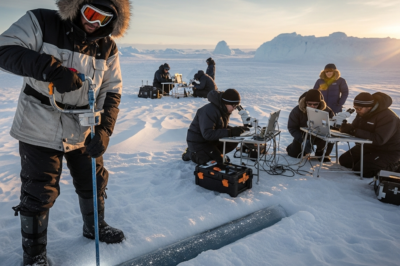
Researchers analyzed 500 kilograms of snow transported from Antarctica to a laboratory in Munich, Germany. By melting the snow and using sensitive mass spectrometry, they isolated the rare atoms. This finding suggests that our solar system is passing through the Local Interstellar Cloud, a region of space filled with gas and dust. This stardust acts as a historical record, helping astronomers map the movement of our sun through the Milky Way and understand the chemical evolution of our cosmic neighborhood. It highlights how terrestrial environments can serve as a canvas for recording the grand history of the universe.
This discovery underscores the profound connection between our home planet and the life cycle of stars. By studying these tiny radioactive particles, scientists can better predict the environment our solar system will encounter in the future, providing a new perspective on our place in the universe and the celestial events that shape our existence.






































Leave a Reply