
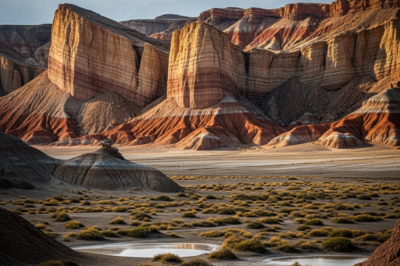
For decades, the standard geological narrative has attributed the dramatic landscape of Central Asia almost entirely to the massive collision between the Indian and Eurasian tectonic plates. However, groundbreaking new research is rewriting this history. Evidence now suggests that a vast, extinct ocean played a defining role in shaping the region’s topography and climate long before the first peaks of the Himalayas ever pierced the sky.
The Silent Architect: The Proto-Paratethys Sea
Before the towering mountain ranges we recognize today were formed, a massive body of water known as the Proto-Paratethys Sea stretched across what is now Central Asia. According to recent geological reconstructions, this epicontinental sea covered vast areas, acting as a primary driver of the region’s early environmental conditions. Researchers have identified sedimentary layers and fossil records that indicate this ocean was not merely a passive feature but a dynamic force that dictated the distribution of landmasses and the movement of tectonic blocks.
Challenging the Indo-Eurasian Dominance
While the collision of India remains a monumental event in Earth’s history, the influence of the receding Paratethys Sea explains several geological anomalies that the Himalayan uplift alone cannot account for. As the ocean retreated due to tectonic shifts and global sea-level changes, it left behind unique mineral deposits and shaped the basins that would eventually become the arid deserts and steppes of the modern Central Asian heartland. This discovery suggests that the terrestrial evolution of the continent was a two-stage process: the maritime influence of the lost ocean followed by the vertical growth of the mountains.
Understanding this prehistoric oceanic influence is more than just an academic exercise; it provides crucial insights into how regional climates evolve over millions of years. By acknowledging the role of the extinct ocean, scientists can better predict how modern landscapes might respond to future geological and climatic shifts. The story of Central Asia is no longer just a story of mountains, but a complex legacy of water and stone.






































Leave a Reply