
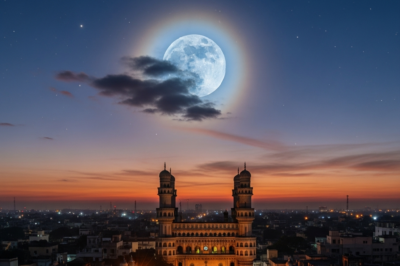
Introduction to a Celestial Rarity
In the bustling heart of Telangana, the city of Hyderabad is bracing for an astronomical event that happens only a few times in a decade. On the night of May 31, the sky over the ‘City of Pearls’ will be graced by the presence of a Blue Micromoon. While the name might evoke images of a sapphire-hued orb, the reality is far more scientifically nuanced and visually subtle. This event represents a unique intersection of two distinct lunar phenomena: the ‘Blue Moon’ and the ‘Micromoon.’ As residents look up from the Hi-Tech City skyscrapers and the historical Charminar alike, they will be witnessing the culmination of celestial mechanics that have fascinated astronomers for centuries. This upcoming event has already sparked a surge of interest among the student community, amateur stargazers, and the scientific elite at the B.M. Birla Science Centre, making it a pivotal moment for science communication in the region. The rarity of this occurrence lies in the timing of the lunar cycle and the elliptical path of the moon, which rarely align to produce a moon that is both the second of the month and at its furthest point from Earth.
The Physics of a Micromoon: Exploring the Lunar Apogee
To understand what makes the May 31 event so special, one must first delve into the elliptical nature of the Moon’s orbit around Earth. Contrary to popular belief, the Moon does not travel in a perfect circle. Instead, it follows an elongated path known as an ellipse. This means that at different points in its 27.3-day orbital cycle, the Moon is either closer to or further away from our planet. The point of closest approach is called ‘perigee,’ while the point of furthest distance is known as ‘apogee.’ When a full moon coincides with its apogee, it is colloquially termed a ‘Micromoon.’ On May 31, the Moon will be positioned at a distance of approximately 405,000 kilometers from Earth, significantly further than its average distance of 384,400 kilometers. From our perspective in Hyderabad, this results in a lunar disk that appears roughly 14 percent smaller and nearly 30 percent dimmer than a ‘Supermoon’ (the counterpart event occurring at perigee). While the casual observer might not immediately notice the change in size, the reduction in luminosity offers a different kind of beauty, allowing for clearer visibility of the lunar maria—the dark basaltic plains formed by ancient volcanic eruptions—without the overwhelming glare of a closer satellite. This subtle shift in scale is a testament to the dynamic nature of our solar system, reminding us that the celestial bodies are in a constant state of flux.
Defining the ‘Blue Moon’: A Terminological History
The second half of this phenomenon’s name, the ‘Blue Moon,’ carries a rich history of linguistic evolution and calendar tracking. Traditionally, there are two ways to define a Blue Moon. The seasonal definition refers to the third full moon in an astronomical season that contains four full moons. However, the more popular ‘calendrical’ definition refers to the second full moon within a single Gregorian calendar month. Because the lunar cycle lasts about 29.5 days and most of our months are 30 or 31 days long, every two to three years, a month manages to squeeze in two full moons. The May 31 event follows this calendrical rule. The first full moon occurred earlier in the month, and this final night of May serves as the encore. Interestingly, the term ‘Blue Moon’ does not refer to the color of the moon itself. The Moon will retain its characteristic pearly-grey or silver-white glow. The phrase ‘once in a blue moon’ likely stems from a rare atmospheric condition where volcanic ash or smoke particles of a specific size scatter red light, making the moon actually appear blue—a phenomenon entirely separate from the orbital timing we are discussing today. The history of the term itself is often traced back to the Maine Farmers’ Almanac, but its modern popularity is largely due to a 1946 article in Sky & Telescope magazine which simplified the rule for the general public.
Observation Prospects in Hyderabad and Telangana
For those residing in Hyderabad, the viewing conditions for the Blue Micromoon are expected to be unique. Given the date is May 31, the city is transitioning from the peak of the summer heat toward the pre-monsoon season. While this often brings clearer skies, late-evening heat haze and localized dust particles can sometimes interfere with visibility. Astronomers recommend heading to areas with minimal light pollution. While the Charminar or the Hussain Sagar lake offer iconic backdrops, the glare from city lights can wash out the subtle details of a Micromoon. Instead, locations like the outskirts of Gachibowli, the campuses of the University of Hyderabad, or the rocky terrain near the Osman Sagar reservoir provide a darker canvas for observation. The B.M. Birla Planetarium in the city is expected to host special sessions, providing high-powered telescopes to the public. For the best experience, observers should look toward the eastern horizon shortly after sunset. As the Moon rises, the ‘Moon Illusion’—an optical phenomenon where the brain perceives the moon as larger when it is near the horizon—might temporarily counteract the ‘micro’ effect, making for a stunning photographic opportunity as the moon climbs above the city’s architectural landmarks. It is advised to reach viewing spots by 7:30 PM to witness the rise and stabilize equipment for a night of stargazing.
The Scientific Significance for Modern Astronomy
While Micromoons are often overshadowed by their more famous siblings, the Supermoons, they hold significant value for the scientific community. By studying the Moon at apogee, researchers can better understand the gravitational interactions between the Earth, Moon, and Sun. The slight variations in the Moon’s distance affect the Earth’s tidal patterns. While a Supermoon might cause ‘King Tides,’ a Micromoon results in slightly lower-than-average high tides and higher-than-average low tides, a phenomenon known as ‘neap tides.’ For oceanographers and those studying the Bay of Bengal’s influence on the Telangana climate, these subtle shifts are important data points. Furthermore, the Micromoon provides an excellent opportunity for lunar mapping. Because the brightness is reduced, high-resolution cameras can capture the depth of craters like Tycho and Copernicus without the sensor blooming that occurs during a Supermoon. This data contributes to our ongoing understanding of the lunar surface, which is increasingly relevant as organizations like ISRO and NASA plan for future manned missions under the Artemis and Chandrayaan programs. Understanding the orbital extremes helps in refining calculations for lunar landings and satellite placements, making the Micromoon a vital study subject for aerospace engineers and astrophysicists alike.
A Guide for Photography and Local Enthusiasts
Capturing the Blue Micromoon requires a bit more technical finesse than a standard full moon. Because the Micromoon is dimmer, photographers in Hyderabad will need to adjust their settings carefully. Using a tripod is non-negotiable to avoid motion blur. For those using DSLR or mirrorless cameras, a focal length of at least 300mm is recommended to make the moon appear substantial in the frame. A low ISO (between 100 and 200) is preferred to minimize noise, while a shutter speed of around 1/125th or 1/250th of a second should be used to account for the Earth’s rotation. Interestingly, the Micromoon offers a chance to practice ‘deep sky’ photography techniques without the moon’s light washing out nearby stars. Amateur astronomers in the Telangana Stargazers group are already preparing to track the moon’s transit, encouraging citizens to use mobile apps like SkyView or Stellarium to locate specific constellations that will be in close proximity to the moon during this event. The convergence of technology and nature on May 31 offers a perfect educational moment for the younger generation in Hyderabad’s schools to learn about the solar system in a practical, hands-on environment. Community workshops are being organized to teach children how to build simple pinhole cameras to view the moon and understand its phase transitions.
Conclusion: Looking Toward the Stars
The arrival of the Blue Micromoon on May 31 is more than just a date on the calendar; it is a reminder of the grand, silent clockwork that governs our universe. For the people of Hyderabad, it serves as an invitation to pause amidst the digital noise and look upward. Whether you are a professional astronomer with a high-end telescope or a curious resident standing on a balcony, the sight of our celestial neighbor at its furthest reach is a humbling and beautiful experience. As the month of May closes with this rare lunar display, it underscores the importance of science literacy and the preservation of our dark skies. This event will not occur again in this specific combination for several years, making the night of May 31 a must-watch event for anyone in Telangana who finds wonder in the vastness of space. The rare alignment of the calendrical Blue Moon with the orbital apogee creates a moment of scientific intersectionality that encourages us to contemplate our place in the cosmos. As we move closer to the date, the anticipation in Hyderabad continues to build, promising a night of quiet reflection and scientific discovery under the dim but elegant glow of the Blue Micromoon. This event marks a perfect conclusion to the month, leaving us with a renewed sense of awe for the mechanics of our galaxy.






































Leave a Reply