
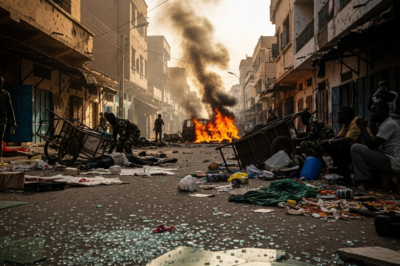
The dawn of a new era of instability seems to have broken over Mali as the capital city of Bamako, once considered a relatively secure bastion compared to the volatile northern regions, was rocked by a series of coordinated attacks, gunfire, and powerful explosions. Reports emerged in the early hours of Tuesday indicating that strategic installations and the private residence of the Defense Minister, Sadio Camara, were among the primary targets. This sudden escalation of violence represents a significant breach of security in a city that serves as the administrative and military heart of the ruling junta. The sounds of heavy weaponry and the sight of smoke billowing from military training facilities have sent shockwaves throughout the region, signaling a daring challenge to the military authorities who seized power with the promise of restoring order. As the smoke clears, the international community is left to grapple with the implications of an insurgency that is no longer confined to the desert fringes but is now knocking on the gates of the capital itself.
The Timeline of Chaos: Unpacking the Attacks in Bamako
The events began in the pre-dawn hours, around 5:00 AM local time, when residents of the Faladie district were jolted awake by the unmistakable sound of sustained gunfire and heavy detonations. The primary focus of the initial assault was a gendarmerie school, a critical training hub for Mali’s internal security forces. Witnesses described a chaotic scene where armed militants attempted to breach the perimeter of the facility, leading to an intense firefight with government troops. Simultaneously, reports surfaced of explosions and gunfire near the Modibo Keita International Airport, a vital lifeline for the landlocked nation. The synchronization of these attacks suggests a high level of planning and intelligence-gathering by the perpetrators. Perhaps most brazen was the targeting of the residence of Defense Minister Col. Sadio Camara, a key figure in the military junta. While the extent of the damage to the residence remains under investigation, the symbolic weight of attacking such a high-profile target cannot be overstated. It highlights a vulnerability in the heart of the state’s security apparatus, challenging the narrative of control maintained by the military leadership.
Strategic Targets: Why the Defense Minister’s Residence?
The decision to target the residence of Sadio Camara is a calculated move by the insurgents to demonstrate their reach and ability to strike at the highest levels of the Malian government. Camara is not just a minister; he is widely seen as one of the architects of Mali’s current security policy, including the pivotal decision to pivot away from Western military partnerships toward a closer relationship with the Russian paramilitary organization, the Wagner Group (now rebranded as the Africa Corps). By bringing the fight to his doorstep, the attackers are attempting to demoralize the military hierarchy and create a sense of pervasive insecurity among the elite. This tactic is reminiscent of insurgent strategies used elsewhere to undermine public confidence in the state’s ability to protect even its most important officials. Furthermore, the attack on the gendarmerie school serves a dual purpose: it disrupts the training of the next generation of security personnel and creates an immediate tactical distraction, forcing the military to redirect resources from the front lines in the north to the urban center of Bamako.
Historical Context: The Long Shadow of Insurgency in Mali
To understand the current crisis, one must look back at the last decade of Malian history. The country has been in a state of flux since the 2012 coup, which was followed by a Tuareg rebellion and a subsequent takeover of the north by Al-Qaeda-linked groups. Although a French-led military intervention in 2013 successfully pushed back the militants from major towns, the insurgency never truly disappeared. Instead, it morphed into a rural guerrilla war, spreading into central Mali and neighboring Burkina Faso and Niger. The failure of the 2015 Algiers Peace Accord to address the root causes of the conflict—marginalization, poverty, and weak governance—allowed extremist groups to recruit among disgruntled local populations. The military coups of 2020 and 2021 were fueled by public frustration over the government’s inability to stem the tide of violence. However, despite the junta’s assertive rhetoric and the deployment of Russian contractors, the security situation has continued to deteriorate. The recent attacks in Bamako are a grim reminder that the conflict has entered a new, more dangerous phase where the distinction between the ‘front line’ and the ‘home front’ is increasingly blurred.
Regional Repercussions: The Sahel’s Volatile Security Landscape
The violence in Bamako does not occur in a vacuum; it is part of a broader regional collapse in security across the Sahel. The formation of the Alliance of Sahel States (AES) by Mali, Burkina Faso, and Niger marks a significant geopolitical shift. These three nations have collectively turned their backs on the Economic Community of West African States (ECOWAS) and traditional partners like France and the United States. This isolationist stance, while framed as a reclamation of sovereignty, has left a vacuum that extremist groups like the Group for the Support of Islam and Muslims (JNIM) are eager to exploit. The withdrawal of the UN peacekeeping mission (MINUSMA) at the request of the Malian junta has further diminished the international community’s ability to monitor human rights and provide logistical support to stabilization efforts. As Mali becomes more reliant on Russian military aid, the nature of the conflict is changing, focusing more on kinetic operations and less on the political reconciliation necessary for long-term peace. The ripple effects of a destabilized Mali could be felt across West Africa, potentially spilling over into coastal states like Ghana, Togo, and Ivory Coast.
The Junta’s Response and the Future of Malian Governance
In the wake of the attacks, the Malian military has doubled down on its commitment to ‘total war’ against the insurgents. State television has aired messages urging for calm and national unity, while military patrols in the capital have been significantly increased. However, the junta faces a daunting challenge: how to maintain popular support while the very security they promised remains elusive. The suspension of political activities and the tightening of control over the media have stifled internal dissent, but they have also limited the avenues for peaceful political expression. The future of Malian governance is currently tied to the success of its military campaigns. If the junta cannot secure the capital and the surrounding areas, its legitimacy will continue to erode. There is also the question of the transition to civilian rule, which has been repeatedly delayed. As long as the country is in a state of emergency, the prospects for democratic elections remain dim, creating a cycle of military rule justified by constant insecurity.
International Reaction and the Looming Humanitarian Crisis
The international response to the Bamako attacks has been one of deep concern. Organizations like the African Union and the United Nations have condemned the violence and called for a return to constitutional order. However, the practical leverage held by the international community is at an all-time low. Sanctions imposed by ECOWAS were largely ineffective and eventually lifted, and the departure of Western forces has left few diplomatic channels open. Meanwhile, the humanitarian situation continues to worsen. Thousands of Malians have been displaced by the fighting, and the disruption of trade routes has led to rising food prices and scarcity. The attack on the airport in Bamako is particularly concerning, as it threatens the delivery of humanitarian aid and the movement of goods essential for the economy. If the capital becomes a theater of war, the resulting humanitarian catastrophe could dwarf anything seen in the north. The resilience of the Malian people is being tested to its limits, and without a comprehensive strategy that addresses both security and socio-economic needs, the path to stability remains fraught with peril.
Conclusion: A Crossroads for Mali
The recent events in Bamako serve as a stark warning that the conflict in Mali is escalating in both scale and complexity. The targeting of high-ranking officials and key military installations in the heart of the capital suggests that the insurgents are becoming more ambitious and capable. For the ruling junta, these attacks are a test of their leadership and their strategic choices. For the people of Mali, they are a terrifying reminder of the fragility of peace. As the nation stands at this crossroads, the need for a multifaceted approach—one that combines security measures with genuine political dialogue and regional cooperation—has never been more urgent. The sounds of gunfire may have faded for the moment, but the underlying tensions that fueled them remain, threatening to ignite a larger conflagration that could consume the entire region. The world must not turn a blind eye to the crisis in Mali, for the stability of the Sahel is inextricably linked to the security of the global community.



































Leave a Reply