
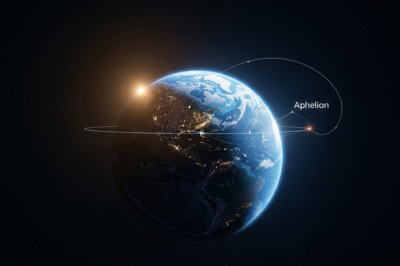
In the early hours of this morning, Earth reached a significant but often overlooked celestial milestone known as aphelion. This is the precise moment in our planet’s annual 365.25-day journey around the Sun when we are at our most distant point from our home star. While many residents in the Northern Hemisphere are currently grappling with sweltering summer heatwaves, the Earth is actually about 5 million kilometers farther from the Sun than it was in early January. This irony highlights one of the most common misconceptions in astronomy: the idea that our distance from the Sun dictates the seasons. In reality, the occurrence of aphelion serves as a masterclass in orbital mechanics, axial tilt, and the complex interplay of forces that govern our planetary climate. Today, Earth sits approximately 152.1 million kilometers away from the Sun, a stark contrast to the perihelion point in January when we were nestled at a mere 147.1 million kilometers. This event is not merely a curiosity for astronomers; it is a fundamental aspect of how our world functions within the solar system, influencing everything from the length of our seasons to the subtle variations in solar radiation received by our atmosphere.
The Mechanics of an Elliptical Orbit: Why We Move Away
To understand aphelion, one must first discard the notion that Earth travels in a perfect circle. As Johannes Kepler discovered in the early 17th century, planetary orbits are elliptical. This means they are slightly elongated, resembling a stretched-out circle or an oval. The degree of this elongation is known as eccentricity. Earth’s current orbital eccentricity is approximately 0.0167, which is relatively low, meaning our orbit is nearly circular but just eccentric enough to create a measurable difference in distance throughout the year. The Sun does not sit at the exact center of this ellipse but rather at one of two focal points. Consequently, as Earth speeds along its orbital path, it inevitably moves closer to and farther away from the solar center. The point of closest approach is called perihelion, which typically occurs around January 3rd, while the point of greatest separation is aphelion, occurring around July 4th or 5th. The gravitational pull of other planets, particularly giants like Jupiter and Saturn, causes slight fluctuations in this distance and the timing of the event over long periods, but the fundamental cycle remains a constant of our existence.
The Great Misconception: Distance vs. Axial Tilt
Perhaps the most persistent myth in elementary science is that summer happens because Earth is closer to the Sun. The timing of aphelion completely debunks this theory for the Northern Hemisphere. If distance were the primary driver of temperature, July would be the coldest month of the year worldwide. Instead, the primary architect of our seasons is the Earth’s axial tilt, which sits at an angle of approximately 23.5 degrees relative to its orbital plane. During aphelion in July, the Northern Hemisphere is tilted toward the Sun, allowing solar rays to strike the surface at a more direct, vertical angle. This concentration of energy, combined with longer daylight hours, far outweighs the 3.4% decrease in solar intensity caused by our increased distance from the Sun. Conversely, the Southern Hemisphere is tilted away during this time, experiencing winter. Interestingly, because Earth is farther away at aphelion, it travels more slowly in its orbit according to Kepler’s Second Law of Planetary Motion. This results in the Northern Hemisphere’s summer being about five days longer than the Southern Hemisphere’s summer, a subtle but fascinating atmospheric dividend of our elliptical path.
Calculating the Solar Constant and Energy Flux
From a physics perspective, aphelion provides a unique opportunity to study the ‘Solar Constant’—the amount of solar electromagnetic radiation per unit area that would be incident on a plane perpendicular to the rays. When Earth is at aphelion, the total solar radiation hitting the top of our atmosphere is about 7% less intense than it is at perihelion. You might expect this to result in a global cooling effect, but the distribution of land and water on Earth creates a surprising counter-effect. The Northern Hemisphere contains the vast majority of the planet’s landmass, while the Southern Hemisphere is dominated by oceans. Land heats up and cools down much more rapidly than water. Because the Northern Hemisphere is experiencing summer during aphelion, the intense heating of its massive continents actually causes the average global temperature of the entire planet to be about 2.3 degrees Celsius (4 degrees Fahrenheit) higher at aphelion than at perihelion, despite the Sun being further away. This paradox underscores the incredible complexity of Earth’s climate system and how it balances astronomical inputs with terrestrial geography.
Historical Context: From Kepler to Modern Telemetry
Our understanding of aphelion has evolved from ancient curiosity to precise mathematical certainty. Ancient Greek astronomers like Hipparchus noted variations in the length of seasons, but it wasn’t until Johannes Kepler published his ‘Astronomia Nova’ in 1609 that the elliptical nature of orbits was mathematically codified. Kepler’s laws broke the Aristotelian tradition of perfect circles, paving the way for Isaac Newton’s law of universal gravitation. In the modern era, we no longer rely solely on visual observation. We use sophisticated telemetry from deep-space probes and radar ranging to calculate the exact moment of aphelion. Organizations like NASA and the Jet Propulsion Laboratory (JPL) track the Earth’s position with centimeter-level precision. This data is crucial for mission planning; for instance, when launching a probe to Mars or the outer planets, engineers must account for the Earth’s specific velocity and position within its elliptical orbit to calculate the most fuel-efficient trajectory. Aphelion is thus a milestone not just for observers on the ground, but for the navigators of the final frontier.
The Milankovitch Cycles and Long-term Orbital Evolution
While we celebrate aphelion as an annual event, it is part of a much larger and slower transition known as the Milankovitch Cycles. Over tens of thousands of years, the shape of Earth’s orbit changes from more circular to more elliptical and back again. This cycle of eccentricity lasts about 100,000 years. Simultaneously, the orientation of Earth’s axis rotates in a process called precession, which functions like a wobbling top. In about 13,000 years, the timing of the seasons will flip relative to the orbit, meaning the Northern Hemisphere will reach perihelion (the closest point) in July and aphelion in January. This shift will likely lead to much more extreme seasonal variations in the Northern Hemisphere, with significantly hotter summers and colder winters. Understanding our current aphelion is a vital baseline for paleoclimatologists who study how these orbital shifts have historically triggered ice ages and interglacial periods. By monitoring the subtle changes in our current orbit, scientists can better predict the long-term climatic future of our planet.
Concluding Thoughts on Our Place in the Cosmos
Earth reaching aphelion is a humbling reminder of our place in the vast mechanical ballet of the solar system. It is a moment that invites us to look upward and consider the invisible forces of gravity and inertia that keep our world in a stable, life-sustaining loop. While the physical distance of 152 million kilometers might seem unfathomable, it is just one variable in the delicate equation that allows life to thrive. The fact that our planet’s farthest point from the Sun coincides with some of our warmest temperatures is a beautiful testament to the power of Earth’s atmosphere and its unique geological makeup. As we pass this point and begin our long, slow fall back toward the Sun for a January rendezvous at perihelion, we are reminded that we live on a dynamic, ever-moving vessel, perfectly tuned to the rhythms of the cosmos. Whether you are a scientist tracking solar flux or a casual observer enjoying a long summer evening, aphelion is a day to appreciate the precision and wonder of the universe we inhabit.







































Leave a Reply