
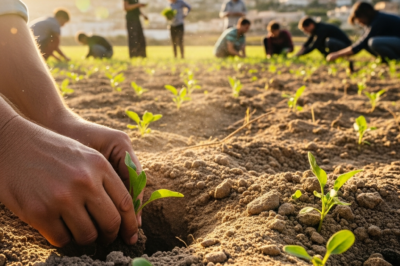
Introduction: The New Frontier of Arable Land
As the global population surges toward an estimated 10 billion by the mid-21st century, the pressure on our planet’s agricultural systems has reached a critical boiling point. Arable land is disappearing at an alarming rate due to urbanization, erosion, and climate-induced desertification. In this high-stakes environment, sandy soils—once dismissed as marginal, unproductive, and difficult to manage—are being reconsidered as a vital frontier for global food security. The recent breakthroughs in managing these challenging terrains are not merely the result of scientific discovery in a vacuum; rather, ‘engagement’ has emerged as the heartbeat of this progress. By fostering a collaborative ecosystem where researchers, local farmers, and international policymakers converge, the agricultural world is witnessing a transformation in how sand-dominated landscapes are utilized. This comprehensive analysis explores why sandy soils are no longer the forgotten stepchild of the agricultural world and how human-centric engagement is driving technological and ecological success. The challenge is immense, but the progress made in recent years suggests that even the most barren-looking landscapes can be turned into productive hubs of life if the right people, technologies, and strategies are brought together in a cohesive manner. Sandy soils represent approximately 900 million hectares globally, and unlocking their potential is no longer an option but a necessity for a hungry world.
The Unique Challenges of Sandy Soil Management
To understand the magnitude of the progress being made, one must first appreciate the inherent physical and chemical difficulties presented by sandy soils. Characterized by large particles and minimal organic matter, sandy soils possess a very low Cation Exchange Capacity (CEC). This means they have a limited ability to hold onto essential nutrients like nitrogen, phosphorus, and potassium. Furthermore, their high porosity leads to rapid water drainage, often leaving crops parched even shortly after irrigation. In regions with high evaporation rates, this becomes a double-edged sword: water disappears into the depths of the earth or evaporates into the atmosphere, leaving the topsoil dry and the plants stressed. Historically, this has led to a cycle of over-fertilization and over-watering, which in turn causes nutrient leaching—a process where fertilizers wash away into the groundwater, causing environmental pollution and toxic algal blooms while leaving the plants undernourished. Moreover, sandy soils are prone to wind erosion, which can strip away the valuable top layer of organic matter in a single storm. However, the shift toward sustainable agriculture has forced a re-evaluation of these traits. Scientists are now looking at the physical and chemical architecture of sand through a different lens, treating the soil not as a static medium but as a dynamic biological system that can be enhanced through specific amendments and management strategies. The progress we see today is built on decades of trial and error, now accelerated by modern data analytics and a renewed focus on soil microbiology and the complex interactions between soil particles and plant roots.
Strategic Engagement: The Bridge Between Laboratory and Field
Perhaps the most significant shift in the last decade is the movement away from ‘top-down’ agricultural interventions. In the past, solutions developed in controlled laboratory environments or university greenhouses often failed when introduced to the complex realities of field farming. The current progress in sandy soil productivity is largely attributed to a new model of ‘engagement.’ This model places the farmer at the center of the research process. In regions like Western Australia, the Middle East, and parts of Sub-Saharan Africa, participatory research programs have allowed farmers to co-design experiments. This ensures that the solutions—whether they be new tillage techniques, crop rotation strategies, or the application of clay-based amendments—are culturally appropriate, economically viable, and practically feasible for the people who actually work the land. Engagement also extends to the global stage, where international organizations like the FAO and various NGOs are facilitating the exchange of knowledge between different arid regions. A breakthrough in the Negev desert might find its way to the Sahel because of these robust engagement networks. This cross-pollination of ideas is essential because sandy soils behave differently under different climatic conditions, and there is no one-size-fits-all solution. By engaging local communities, researchers can tap into traditional ecological knowledge, combining it with modern science to create hybrid systems that are more resilient than either approach would be on its own. This human-centric approach has proven that the social dimensions of agriculture are just as important as the chemical ones.
Technological Innovations: Amending the Physical Foundation
Technological advancement is a key pillar of the progress being made on sandy terrains. One of the most promising areas of research involves soil amendments designed to fundamentally alter the soil’s structure and its ability to hold onto life-sustaining elements. ‘Claying’ is a prime example of this innovation. While adding clay to sand is an old practice, modern precision machinery allows for ‘delving’ and ‘spading’ with surgical accuracy, ensuring the clay is mixed at the optimal depth to maximize water retention without hindering root growth. Another exciting development is the use of biochar—a carbon-rich substance created by heating organic biomass in the absence of oxygen. When integrated into sandy soils, biochar acts like a molecular sponge, holding onto water and providing a habitat for beneficial microbes that fix nitrogen and protect plants from diseases. Furthermore, the development of sophisticated hydrogels—polymers that can absorb and retain hundreds of times their weight in water—is providing a safety net for crops during dry spells. These hydrogels act as reservoirs that release water slowly as the plant needs it, significantly reducing the frequency of irrigation required. These technologies, however, require careful management and a deep understanding of local soil chemistry. Without proper engagement and education, these tools can be misapplied, leading to wasted resources. The success stories of the last five years have all featured a strong educational component where farmers are trained not just to use the technology, but to understand the science behind it.
Precision Agriculture and the Data Revolution in Arid Lands
In the era of the ‘Internet of Things’ (IoT), sandy soils are being monitored with a level of detail that was previously unimaginable. Precision agriculture is particularly effective in sandy environments because the margin for error is so slim; a few hours of missed irrigation can be the difference between a bumper crop and a total loss. Sensors placed in the field can provide real-time data on soil moisture levels, temperature, and nutrient concentrations. This data is then transmitted to automated irrigation systems that deliver precise amounts of water and liquid fertilizer directly to the root zone, a process known as ‘fertigation.’ By minimizing waste and ensuring that every drop of water counts, precision agriculture makes farming on sandy soils economically competitive with more naturally fertile lands. Moreover, satellite imagery and drone technology are being used to map soil variability across vast distances. This allows for site-specific management, where a farmer might treat one section of a field with high-dose organic amendments while leaving another section that is already performing well. The integration of Artificial Intelligence (AI) is the next step, with algorithms now capable of predicting crop yields based on soil health trends and weather forecasts. This allows for proactive rather than reactive management, giving farmers the ability to prepare for droughts or heatwaves before they strike. This digital transformation is only possible through engagement between tech companies and the agricultural sector, ensuring that the software developed is user-friendly and addresses the actual needs of the field.
Policy Frameworks and the Economic Incentive for Progress
The transformation of sandy soils is not just a scientific or technological challenge; it is a profoundly economic one. Governments and international bodies are increasingly recognizing that investing in soil health is a primary form of climate change mitigation. Healthy soils sequester more carbon, and improving the productivity of sandy lands can prevent the clearing of forests and grasslands for new agricultural space. Policy frameworks that provide subsidies for soil amendments, tax breaks for water-saving technologies, or carbon credits for improved soil management are providing the financial backbone for these massive projects. Furthermore, the engagement of the private sector—ranging from multinational agricultural firms to local startups—is driving down the cost of technology through competition and innovation. In many parts of the world, impact investors are looking at sandy soil restoration as a high-reward ESG (Environmental, Social, and Governance) opportunity. By aligning economic incentives with ecological outcomes, these policies ensure that the progress made is not just a temporary spike but a long-term shift toward sustainable land use. The ‘engagement’ here involves a complex negotiation between the public’s need for food security and the private sector’s need for a return on investment. In countries like China and Saudi Arabia, large-scale government-backed projects have shown that with enough political will and financial backing, even deserts can be made to support agricultural life. These macro-level engagements are essential for scaling up the micro-level successes seen in individual research plots.
Conclusion: A Greener Future Rooted in Collaboration
The progress being made in the realm of sandy soils is a testament to human ingenuity and the power of collective action. By placing engagement at the heart of the strategy, the global agricultural community has moved beyond the physical limitations of the soil itself. We are no longer defined by the constraints of the sand, but by the strength of our collaborations and the sophistication of our science. As we look to the future, the lessons learned from reclaiming sandy soils will serve as a blueprint for addressing other environmental challenges, from water scarcity to global warming. It serves as a reminder that with the right combination of technology, community involvement, and policy support, even the most barren landscapes can be made to bloom. The journey of sandy soil progress is ongoing, but the foundation has been laid for a more resilient and food-secure world. The engagement continues, the science evolves, and the sand, once a symbol of desolation and agricultural failure, is becoming a canvas for the next green revolution. As we move forward, the focus must remain on inclusivity—ensuring that smallholder farmers in developing nations have the same access to these breakthroughs as large-scale industrial operations. Only then will the progress in sandy soils truly be a global victory for humanity.






































Leave a Reply