
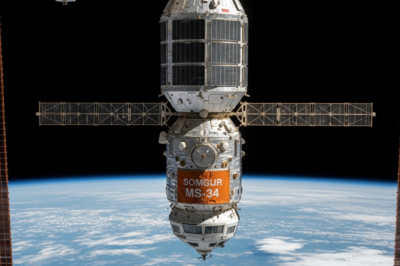
The Lifeline of Low Earth Orbit: Understanding the MS-34 Mission
In the silent, vacuum-sealed expanse of space, the International Space Station (ISS) stands as a testament to human ingenuity and international cooperation. However, maintaining a continuous human presence 250 miles above the Earth is not merely a feat of engineering; it is a monumental logistical challenge. The recent launch of the MS-34 cargo spacecraft—a vital component of the Progress MS series—represents the latest chapter in this ongoing effort. For decades, these uncrewed vessels have served as the vital lifeline for the ISS, carrying the essential supplies, scientific equipment, and life-support materials necessary for the survival and success of the astronauts and cosmonauts stationed aboard the orbital laboratory.
The MS-34 mission, though often perceived as a routine logistical run, is anything but ordinary. Each cargo launch is a precision-engineered operation that requires the synchronization of thousands of variables, from atmospheric conditions at the launch site to the exact orbital mechanics of the ISS. As the global space community looks toward the future of lunar exploration and Mars missions, the reliability of cargo ships like the MS-34 remains the foundation upon which all other celestial ambitions are built. This article provides an exhaustive analysis of what the MS-34 spacecraft is, the intricacies of its launch, and its critical role in the broader context of NASA and Roscosmos operations.
The Anatomy of the Progress MS-34 Spacecraft
The MS-34 is the latest iteration of the venerable Progress spacecraft, a design that has been the workhorse of the Soviet and Russian space programs since 1978. While the exterior may look similar to its predecessors, the MS series features significant upgrades in its navigation, docking, and communication systems. The spacecraft is divided into three primary modules: the pressurized cargo module, the refueling module, and the instrumentation and propulsion module.
The pressurized cargo module is where the majority of the dry goods are stored. This includes food rations, medical supplies, clothing, and the high-priority scientific experiments that drive the station’s research agenda. Once docked, the crew enters this module to offload supplies. The refueling module, conversely, carries liquid propellants. These are used not only for the station’s own maneuvering engines but also to perform ‘re-boost’ maneuvers, which raise the ISS’s altitude to counteract the effects of atmospheric drag. Finally, the instrumentation module contains the brains of the ship—the Kurs-NA automated docking system, solar arrays, and the propulsion systems that guide the craft from the launch pad to the station’s docking port.
Launch Logistics: From Baikonur to the Stars
The journey of the MS-34 began at the historic Baikonur Cosmodrome in Kazakhstan, the world’s first and largest operational space launch facility. Mounted atop a Soyuz-2.1a carrier rocket, the MS-34 was propelled into orbit with surgical precision. The launch sequence is a multi-stage process that involves the separation of the four liquid-fueled boosters, the jettisoning of the payload fairing, and finally, the insertion of the spacecraft into its initial parking orbit.
Once in orbit, the MS-34 does not immediately dock with the ISS. Instead, it follows a carefully calculated trajectory known as a ‘fast-track’ or ‘ultra-fast’ rendezvous. Depending on the orbital alignment, the spacecraft can reach the station in as little as three hours or up to two days. During this time, the onboard computers execute a series of engine burns to refine the approach. The final stages of the journey are governed by the Kurs-NA system, which allows the MS-34 to dock autonomously with the Russian segment of the ISS. While the crew remains on standby to take manual control using the TORU system if necessary, the automation is so advanced that human intervention is rarely required.
The Payload: Fueling Science and Survival
What exactly is inside the MS-34? The payload of a cargo mission is a meticulously curated manifest that reflects the immediate needs of the ISS crew. For the MS-34 mission, the cargo weight typically exceeds 2.5 tons. This includes approximately 1,500 kilograms of dry cargo, 500 kilograms of fuel to replenish the station’s tanks, 400 kilograms of potable water, and dozens of kilograms of compressed nitrogen and oxygen to maintain the station’s atmosphere.
Beyond the basics of survival, the MS-34 is a vessel for discovery. It carries new hardware for scientific racks, including biological samples that require microgravity to grow and crystallize. For instance, many missions deliver hardware for ‘3D Bioprinting’ and material science experiments that investigate how alloys form without the interference of Earth’s gravity. These experiments are critical for developing new medicines and stronger materials for use both on Earth and in deep-space exploration. The arrival of a cargo ship is often a moment of excitement for the crew, as it occasionally brings ‘fresh food’—fruits and vegetables—and personal care packages from home, which provide a significant psychological boost for long-duration missions.
International Cooperation in an Era of Complexity
The MS-34 mission highlights the enduring partnership between NASA and Roscosmos, despite the complexities of global geopolitics. The International Space Station is partitioned into the Russian Orbital Segment (ROS) and the United States Orbital Segment (USOS), but they function as a single, integrated unit. The MS-34 docks specifically to the Russian ports (such as the Poisk or Prichal modules), but the resources it provides—specifically the re-boost capabilities—benefit the entire station.
NASA relies on these Progress missions to maintain the station’s orbital stability. While US-based commercial partners like SpaceX (with the Cargo Dragon) and Northrop Grumman (with the Cygnus) provide a significant portion of the logistics, the Progress spacecraft remains unique in its ability to refuel the station’s integrated propulsion system directly. This synergy ensures that if one launch provider faces a delay or failure, the station has redundant methods of receiving supplies. This ‘cross-platform’ reliability is the cornerstone of the ISS program’s success over the last two decades.
Waste Management and the End of Mission
One of the less discussed but equally important roles of the MS-34 is its function as a garbage disposal unit. The ISS does not have a traditional waste management system; everything that goes up must eventually come down or be disposed of. Once the MS-34 is emptied of its supplies, the crew gradually fills it with several tons of waste, including used equipment, packaging material, and liquid waste.
After several months attached to the station, the MS-34 will undock. Unlike the SpaceX Dragon, which is designed to survive atmospheric reentry and splash down in the ocean, the Progress MS-34 is an expendable craft. It is commanded to perform a deorbit burn that sends it plunging into the Earth’s atmosphere. The friction of reentry causes the spacecraft and its contents to incinerate over a remote area of the South Pacific Ocean, often referred to as the ‘Spacecraft Cemetery.’ This process ensures that no debris is left in orbit to threaten other satellites or the ISS itself.
Future Outlook: The Transition to Commercial Space
As we look toward the 2030s, the role of missions like MS-34 is evolving. NASA has announced plans to eventually transition from the ISS to commercially operated space stations. However, the lessons learned from the MS-34 and its predecessors are being integrated into the next generation of cargo vehicles. Companies like Sierra Space are developing the ‘Dream Chaser’ spaceplane, and various international agencies are looking at reusable cargo modules.
The MS-34 stands as a bridge between the heroic era of early space exploration and the burgeoning era of the commercial space economy. It reminds us that before we can walk on the moon again or set foot on Mars, we must master the art of the ‘supply chain in the sky.’ The success of the MS-34 is not just a win for the engineers who built it, but for the global scientific community that relies on the ISS to push the boundaries of what is possible for humanity.
Conclusion
The launch and docking of the MS-34 cargo spacecraft is a masterclass in aerospace engineering and international logistics. By delivering tons of fuel, food, and scientific hardware, it ensures that the International Space Station remains a vibrant hub of research and discovery. As the MS-34 mission concludes its tenure in orbit, it reinforces the vital importance of redundant, reliable cargo systems in the quest to explore the final frontier. It is a silent sentinel of progress, ensuring that as we look up at the stars, the pioneers living among them have everything they need to succeed.






































Leave a Reply