
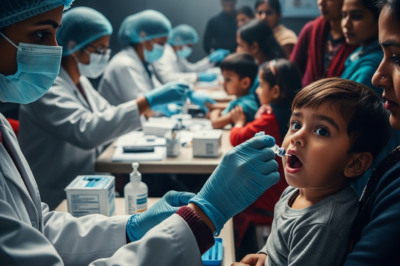
The discovery of poliovirus fragments in the sewage systems of Ghaziabad has sent shockwaves through the public health infrastructure of Uttar Pradesh and the National Capital Region. For a nation that was officially declared polio-free by the World Health Organization in 2014, any sign of the virus, even in environmental samples, is treated as a high-priority emergency. The headline, ‘No child has been missed, right?’, captures the palpable anxiety and the relentless dedication of the thousands of health workers who have been mobilized to ensure that the virus does not find a human host to replicate and spread. This detection serves as a stark reminder that while the wild poliovirus may have been eradicated from Indian soil, the threat of vaccine-derived strains and the risk of importation remain constant challenges in an increasingly interconnected world.
India’s journey toward eradication was one of the greatest public health achievements in history. For decades, the country accounted for nearly half of the world’s polio cases. The success of the Global Polio Eradication Initiative in India was built on the back of massive immunization campaigns, rigorous surveillance, and a workforce that reached every corner of the sub-continent. However, the recent environmental find in Ghaziabad necessitates a deep dive into the logistics of contemporary polio surveillance, the scientific nuances of vaccine-derived poliovirus, and the socio-economic factors that make certain urban pockets more vulnerable than others.
The Ghaziabad Discovery: A Wake-Up Call for Public Health
The detection occurred during routine environmental surveillance, a process where sewage samples are collected from designated sites and tested in specialized laboratories. In Ghaziabad, a city characterized by its rapid urbanization and high population density, the presence of Type-2 Vaccine-Derived Poliovirus (VDPV) was confirmed. It is crucial to distinguish this from the wild poliovirus. VDPV occurs when the weakened virus contained in the oral polio vaccine (OPV) circulates in under-vaccinated populations for an extended period. During this circulation, it can undergo genetic changes that allow it to regain the ability to cause paralysis. The discovery in Ghaziabad indicates that there is a pocket of the population where immunity levels might not be optimal, allowing the vaccine strain to persist and mutate in the environment.
Upon receiving the lab results, the health department immediately swung into action. This was not a localized response but a coordinated strategic offensive. The ‘mop-up’ rounds were initiated, targeting high-risk areas, construction sites, and transit points. The goal is simple yet Herculean: ensure every single child under the age of five receives the booster dose to break any potential chain of transmission. The urgency is dictated by the fact that for every one case of paralysis, there may be hundreds of subclinical infections where the virus is being shed into the environment, silently putting the entire community at risk.
Mobilizing the Frontline: The Intense Door-to-Door Search
The core of the response lies with the ‘boots on the ground’—the ASHA workers, ANMs, and volunteer teams who navigate the labyrinthine lanes of Ghaziabad. Their mission is characterized by the repeated question: ‘No child has been missed, right?’ This isn’t just a query; it’s a mantra of accountability. These workers carry blue vaccine carriers packed with ice to maintain the cold chain, ensuring the potency of the vaccine isn’t compromised by the sweltering heat. They mark houses with chalk, indicating when a team visited and whether all children were vaccinated or if some were ‘X’ (missed) due to absence or refusal.
The logistics are staggering. Teams must account for children of migrant laborers who move between construction sites, families living in unauthorized colonies with poor sanitation, and even those in high-rise apartments who might be complacent about the risk. The ‘missed child’ is the greatest vulnerability. Workers often return to ‘X’ houses late in the evening, hoping to catch parents who were away at work during the day. This level of granular tracking is what prevented polio outbreaks in the past and is what is being replicated now to contain the current threat. The pressure on these frontline workers is immense, as they are the primary barrier between a managed environmental find and a full-blown public health crisis.
Science of the Strain: Decoding Vaccine-Derived Poliovirus (VDPV)
To understand why this discovery is significant, one must understand the biology of the Oral Polio Vaccine (OPV). The OPV contains a live, attenuated (weakened) virus. When a child is vaccinated, the weakened virus replicates in the intestine for a limited period, triggering an immune response. During this time, the virus is excreted. In areas with poor sanitation, this excreted vaccine-virus can spread to others in the community, providing ‘passive’ immunization. However, if the community is significantly under-vaccinated, this virus can continue to circulate for 12 to 18 months. As it passes from one person to another, it can mutate. If it mutates enough, it becomes a VDPV, which behaves much like the wild poliovirus.
The detection of Type-2 VDPV is particularly sensitive. In 2016, the world underwent a ‘switch’ from the trivalent OPV (which covered types 1, 2, and 3) to a bivalent OPV (covering only types 1 and 3) because Type-2 wild polio had been eradicated globally. The continued presence of Type-2 VDPV in environmental samples suggests that the transition and the subsequent use of the Inactivated Polio Vaccine (IPV) must be monitored with extreme precision. It highlights the delicate balance of global health policy where the tools used to eradicate a disease must be managed carefully to prevent them from becoming the source of new outbreaks.
Environmental Surveillance: The Silent Sentinel
India’s polio surveillance system is considered the gold standard globally. It consists of two main pillars: Acute Flaccid Paralysis (AFP) surveillance and environmental surveillance. AFP surveillance involves investigating every case of sudden limb weakness in children. However, relying solely on AFP would mean waiting for a child to be paralyzed before detecting the virus. This is where environmental surveillance—or ‘sewage testing’—becomes the silent sentinel. By testing sewage, health officials can detect the presence of the virus even when no human cases of paralysis have been reported.
In Ghaziabad, the environmental surveillance system worked exactly as intended. It provided an early warning, allowing for a preemptive strike before the virus could manifest in a clinical case. This proactive approach is the reason why India has remained polio-free for over a decade. The frequency of sampling and the density of collection sites have been increased in response to the find. This high-tech laboratory back-end combined with the low-tech but essential door-to-door front-end creates a comprehensive safety net that is currently being tested to its limits.
The Migratory Challenge: Why Urban Pockets Remain Vulnerable
Ghaziabad is a quintessential example of the challenges posed by rapid, often unplanned, urban growth. As an industrial hub bordering Delhi, it attracts a massive influx of migratory populations from various parts of India. These populations are often mobile, living in temporary settlements or ‘bastis’ where documentation and health records may be sparse. This mobility makes it difficult for health teams to maintain a consistent immunization schedule. A child might receive one dose in their home village in Bihar and the next in a construction camp in Ghaziabad, or they might miss the cycle entirely during the transition.
Furthermore, the sanitation infrastructure in these high-density pockets often lags behind the population growth. Open drains and poor waste management systems facilitate the environmental spread of waterborne pathogens, including the poliovirus. The intersection of high population density, constant migration, and suboptimal sanitation creates a ‘perfect storm’ for the persistence of VDPV. Addressing the polio risk in Ghaziabad, therefore, is not just a medical task but a socio-economic one that involves improving living conditions and ensuring that the most marginalized and mobile populations are integrated into the public health system.
Global Implications and India’s Strategic Response
The discovery in Ghaziabad is not just a local concern; it is a matter of international significance. As long as the poliovirus exists anywhere in the world, every country remains at risk. The Global Polio Eradication Initiative (GPEI) monitors these environmental finds closely. India’s response serves as a template for other countries. The strategy involves not only the ‘mop-up’ rounds but also strengthening the Routine Immunization (RI) program. The introduction of the Inactivated Polio Vaccine (IPV) as an injectable dose alongside the OPV has been a critical part of this strategy, providing systemic immunity that prevents the virus from reaching the nervous system.
The government’s response also involves intense communication and social mobilization. Overcoming vaccine hesitancy, which can sometimes crop up in specific communities due to misinformation, is a key component. Local influencers, religious leaders, and community heads are engaged to build trust. The message is clear: the polio vaccine is safe, effective, and necessary. The current campaign in Ghaziabad is a testament to the political will and the resource allocation that India continues to dedicate to a disease that many might consider a ‘problem of the past.’ The reality is that the final mile of eradication is the hardest, requiring more precision and persistence than ever before.
In conclusion, the situation in Ghaziabad is a powerful reminder of the fragility of public health successes. The question ‘No child has been missed, right?’ should resonate with every stakeholder in the health sector. It reflects a commitment to 100% coverage that is the only acceptable standard when dealing with a disease as devastating as polio. While the detection of the virus in sewage is a cause for concern, the speed and scale of the response demonstrate the resilience of India’s healthcare system. By maintaining high levels of immunity and rigorous surveillance, the goal is to ensure that the poliovirus is finally and permanently relegated to the history books, ensuring a future where no child has to face the threat of preventable paralysis.






































Leave a Reply