
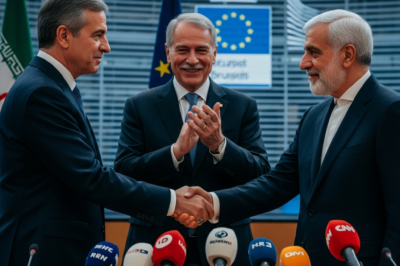
The landscape of West Asian geopolitics has undergone a tectonic shift that many observers thought impossible only months ago. In a diplomatic breakthrough that has sent ripples through the international community, European Union Commission President Ursula von der Leyen has officially hailed the recent agreement between the United States and Iran as a seminal moment in modern history. Describing the cessation of hostilities and the formalization of a new diplomatic framework as the end of a “costly war,” the EU chief’s remarks underscore a profound sense of relief shared by Brussels and other global capitals. For years, the specter of a direct military confrontation in West Asia has loomed large, threatening not only regional stability but also global energy markets and international security architectures. This newfound consensus, emerging after months of grueling back-channel negotiations and mediation by regional partners like Oman and Qatar, represents perhaps the most significant realignment in Middle Eastern affairs since the original 2015 nuclear deal. As the world watches, the agreement promises a path toward de-escalation, sanctions relief, and a return to multilateral engagement, marking a pivot away from the “maximum pressure” tactics that have defined the last half-decade. The significance of this moment cannot be overstated, as it marks a transition from the brink of kinetic warfare back to the table of high-stakes diplomacy, offering a rare glimmer of hope in a region long plagued by cyclical violence and ideological division.
The Genesis of the Agreement: From Brinkmanship to Breakthrough
The road to this historic accord was paved with years of diplomatic brinkmanship and economic attrition. Following the unilateral withdrawal of the United States from the Joint Comprehensive Plan of Action (JCPOA) in 2018, the relationship between Washington and Tehran plummeted to historic lows. The subsequent “maximum pressure” campaign, characterized by crippling economic sanctions and the assassination of high-ranking officials, led Iran to systematically breach its nuclear commitments, bringing the two nations to the edge of open conflict several times. However, the realization that neither side could achieve a decisive victory through coercion alone eventually led to a strategic rethink. Under current international pressures, including the shifting global energy landscape and the ongoing conflicts in Eastern Europe, the incentive to stabilize West Asia became a top priority for both the Biden administration and the leadership in Tehran. This deal is not merely a return to the status quo; it is a comprehensive framework that addresses not only nuclear enrichment levels but also provides a roadmap for regional security coordination and the release of frozen assets. The meticulous crafting of this agreement involved hundreds of hours of technical discussions in Vienna and Geneva, where diplomats worked to balance Iran’s demands for economic guarantees with the U.S. requirements for verifiable oversight and regional safety. This genesis reflects a pragmatic realization that a “costly war”—whether fought through proxy forces or direct military strikes—would yield no true winners, only further destabilization.
The European Union’s Strategic Role as a Mediator
Throughout the period of heightened tension, the European Union maintained a precarious yet vital role as the primary mediator between the two adversaries. The EU’s commitment to the preservation of diplomatic channels was driven by its own strategic interests. For Europe, a stable West Asia is crucial for energy security, particularly as the continent seeks to diversify its gas and oil sources away from traditional providers. Ursula von der Leyen’s endorsement of the deal highlights the EU’s success in keeping the dialogue alive when bilateral relations between the U.S. and Iran were virtually non-existent. By leveraging the E3 (France, Germany, and the UK) and its high-representative for foreign affairs, the EU provided the neutral ground necessary for technical experts to hammer out the details of the accord. The “costly war” narrative mentioned by the EU chief also refers to the economic fallout that European businesses suffered due to secondary sanctions, which halted billions of dollars in potential trade and investment. With the deal now in place, the EU expects to revitalize its trade relations with Iran, potentially opening up markets in the automotive, pharmaceutical, and technology sectors. Furthermore, the stabilization of the region is expected to mitigate the pressures of irregular migration, an issue that remains at the top of the European political agenda. This agreement validates the EU’s long-standing belief in multilateralism as the most effective tool for resolving complex international crises.
Geopolitical Repercussions Across West Asia
The impact of a U.S.-Iran rapprochement will be felt most acutely within the complex web of regional alliances in West Asia. For decades, the rivalry between Tehran and its neighbors, often supported by Washington, has fueled proxy wars in Yemen, Syria, and Lebanon. With this new agreement, there is a cautious expectation that these frozen or active conflicts may finally see a path toward resolution. In Yemen, the prospect of reduced Iranian support for Houthi rebels in exchange for regional legitimacy could hasten the ongoing peace talks with Saudi Arabia. Similarly, in Lebanon, the easing of tensions could provide the necessary political space for the country to resolve its paralyzing economic and leadership crises. However, the deal has not been met with universal acclaim. Israel has voiced significant concerns, fearing that any sanctions relief will provide Iran with the financial resources to further empower its regional proxies and advance its ballistic missile program. The Netanyahu government has emphasized that it does not consider itself bound by the agreement and reserves the right to act independently to ensure its national security. This highlights the delicate balancing act that Washington must now perform: reassuring its traditional allies in the Middle East while simultaneously implementing a deal that reintegrates Iran into the global fold. The regional response is therefore a mix of hope for a new era of cooperation and a lingering fear of shifting power dynamics.
Economic Implications: Oil, Markets, and Sanctions Relief
Perhaps the most immediate and tangible effect of the U.S.-Iran deal will be seen in the global economy. Iran sits on some of the world’s largest proven reserves of oil and natural gas, much of which has been kept off the global market due to strict U.S. sanctions. The deal outlines a phased lifting of these restrictions, which is expected to result in an additional 1 to 1.5 million barrels of Iranian crude entering the market daily within the next year. This influx of supply comes at a critical time for the global economy, as central banks continue to battle inflation and energy prices remain volatile due to geopolitical instability elsewhere. Beyond oil, the agreement facilitates the unfreezing of tens of billions of dollars in Iranian assets held in foreign banks. These funds are earmarked for humanitarian purposes, infrastructure development, and the stabilization of the Iranian Rial, which has suffered devastating devaluations. For international investors, the deal represents the opening of one of the last great frontier markets. Iran’s young, educated workforce and its strategic location at the crossroads of Europe, Asia, and the Middle East make it an attractive prospect for long-term investment, provided the legal and political frameworks remain stable. However, the “costly war” of sanctions has left deep scars on the Iranian economy, and the recovery process is expected to be slow and fraught with bureaucratic hurdles.
Internal Challenges and the Threat of Policy Reversal
Despite the optimism expressed by the EU and the negotiating parties, significant internal challenges remain in both Washington and Tehran. In the United States, the deal faces fierce opposition from a divided Congress. Critics argue that the agreement provides too much for too little, granting Iran economic a life-line without addressing its broader regional behavior or long-term nuclear ambitions. The memory of the 2018 withdrawal serves as a cautionary tale; without a formal treaty—which is unlikely to pass the U.S. Senate—the agreement remains an executive arrangement that could be overturned by a future administration. This “political risk” makes international corporations hesitant to commit to large-scale, long-term projects in Iran. Conversely, in Tehran, the ruling establishment must navigate the expectations of a population weary of economic hardship while managing the concerns of hardliners who view any compromise with the “Great Satan” as a betrayal of revolutionary principles. The Supreme Leader’s endorsement of the deal is a crucial stabilizing factor, but the internal power struggle between pragmatists and ideologues continues to influence the pace of implementation. For the deal to be truly sustainable, it must demonstrate tangible benefits to the Iranian public while providing the U.S. with the verifiable security assurances it needs to maintain domestic political support. The risk of a “costly war” has not been entirely eliminated; it has merely been replaced by a “costly peace” that requires constant maintenance and political courage.
Conclusion: A New Era of Strategic Diplomacy
The hailing of the U.S.-Iran deal by EU chief Ursula von der Leyen marks a definitive end to a period of unprecedented tension and the beginning of a complex, multifaceted era of engagement. This agreement proves that even the most entrenched and ideological conflicts can be mitigated through patient, multilateral diplomacy. While the term “costly war” serves as a reminder of what was narrowly avoided, the focus must now turn to the rigorous implementation and monitoring of the accord. The world stands at a crossroads where the success of this deal could lead to a broader regional security framework, potentially transforming West Asia from a zone of perpetual conflict into a hub of global trade and cultural exchange. However, the path forward remains littered with obstacles, from the skepticism of regional allies to the volatility of domestic politics in the signatory nations. As the first shipments of oil begin to move and the first inspections are carried out, the international community must remain vigilant and committed to the process. The end of the “costly war” is not the final destination, but rather the essential starting point for a more stable, prosperous, and peaceful global order. The coming months will be the true test of whether the pragmatism that birthed this deal can survive the rigors of reality.



































Leave a Reply