
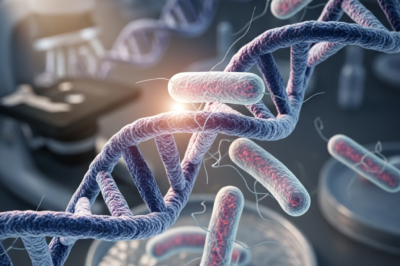
For much of the early twentieth century, the greatest mystery in biology was not the origin of species or the structure of the cell, but the physical nature of inheritance itself. While Gregor Mendel had established the laws of heredity and Thomas Hunt Morgan had mapped genes to chromosomes, no one knew what a gene actually was. Most scientists were convinced that the secret lay in proteins. Proteins were complex, diverse, and found in abundance within chromosomes. In contrast, Deoxyribonucleic Acid (DNA) was viewed as a boring, repetitive molecule composed of only four basic building blocks, seemingly incapable of carrying the vast blueprint of life. It took the humble world of bacteria and the viruses that infect them to shatter this misconception and launch the molecular revolution. This article explores how microbial research provided the key to unlocking the code of life, a journey that transitioned from the macroscopic observations of peas to the microscopic manipulation of Escherichia coli and Streptococcus pneumoniae.
The Protein Paradigm and the Genetic Enigma
In the 1930s, the scientific community was firmly entrenched in the ‘protein paradigm.’ Because proteins are made of twenty different amino acids, their potential for structural variety seemed infinite. DNA, identified decades earlier by Friedrich Miescher, was thought to be a mere structural scaffold for these proteins. The prevailing ‘tetranucleotide hypothesis’ proposed that DNA consisted of repeating units of the same four bases in a fixed, invariant order. Under this view, DNA was as interesting as a brick wall; it was the ‘living’ proteins that supposedly acted as the architects of heredity. The breakthrough required a shift in focus toward the simplest possible biological systems: bacteria. At the time, many biologists didn’t even believe bacteria had genes in the traditional sense, as they lacked visible nuclei and chromosomes. However, the work of Fred Griffith in 1928 provided the first hint of a ‘transforming principle’ when he observed that non-virulent bacteria could acquire the lethal traits of heat-killed virulent strains. The race was on to identify what substance caused this transformation.
The Avery-MacLeod-McCarty Experiment: The First Crack in the Armor
By 1944, three researchers at the Rockefeller Institute—Oswald Avery, Colin MacLeod, and Maclyn McCarty—embarked on a rigorous quest to purify Griffith’s transforming principle. They meticulously isolated various components from heat-killed ‘S-strain’ (smooth, virulent) bacteria, including proteins, lipids, carbohydrates, and DNA. They then tested these components to see which one could transform ‘R-strain’ (rough, non-virulent) bacteria into the virulent form. To the shock of the scientific establishment, only DNA produced the transformation. To prove it wasn’t a protein contaminant, they treated the transforming substance with enzymes that digest proteins (proteases) and RNA (RNase), but the transforming activity remained. Only when they added DNA-digesting enzymes (DNase) did the activity vanish. Despite this overwhelming evidence, the scientific community was hesitant. Critics argued that DNA was too simple and that trace amounts of protein must be responsible. The legacy of the Avery-MacLeod-McCarty experiment is now seen as the true birth of molecular biology, yet it took another microbial study to finalize the debate.
Hershey and Chase: The Blender Experiment that Changed Everything
The definitive proof that DNA was the genetic material came in 1952 from Alfred Hershey and Martha Chase. Their experimental model was the bacteriophage, a virus that infects bacteria. A phage is essentially a protein shell containing a DNA core. When a phage infects a bacterium, it hijacks the cell to produce more viruses. Hershey and Chase sought to determine whether the virus was injecting protein or DNA into the host. They used radioactive isotopes to label the components: Phosphorus-32 for DNA (since DNA contains phosphorus but protein does not) and Sulfur-35 for protein (since protein contains sulfur but DNA does not). After allowing the phages to infect E. coli, they used a common kitchen blender to shear off the viral shells from the bacterial surfaces. Upon centrifugation, they found that the radioactive phosphorus was inside the bacteria, while the radioactive sulfur remained in the fluid outside. This ‘Waring Blender’ experiment proved beyond doubt that DNA was the carrier of genetic information, providing the physical basis for inheritance that had eluded scientists for generations.
Why Bacteria? The Advantages of Microbial Models
The success of these experiments was not accidental; it was a direct result of choosing bacteria as model organisms. Bacteria offer several unique advantages for genetic research. First, their generation time is incredibly short—E. coli can double its population every twenty minutes. This allows researchers to observe evolutionary changes and genetic transmissions in days rather than years. Second, bacteria are haploid, meaning they have only one set of genes. In diploid organisms like humans or fruit flies, recessive mutations can be masked by a dominant gene, making genetic analysis complex. In bacteria, any mutation is immediately visible in the phenotype. Third, the ability to grow billions of bacteria in a single flask provided the statistical power necessary to detect rare genetic events. Figures like Joshua Lederberg and Edward Tatum exploited these features to discover bacterial conjugation, essentially a form of microbial ‘sex’ that allowed genes to be exchanged between cells, further proving that bacteria possessed a organized genetic system comparable to higher organisms.
From Microbial Genetics to the Molecular Revolution
Once bacteria had identified DNA as the genetic material, the focus shifted to its structure. The work of Rosalind Franklin, Maurice Wilkins, James Watson, and Francis Crick culminated in the 1953 model of the double helix. However, the story didn’t end with the structure. The next great challenge was the ‘coding problem’: how does a sequence of four bases translate into a sequence of twenty amino acids? Again, bacteria provided the answer. Throughout the late 1950s and 60s, researchers like Marshall Nirenberg and Har Gobind Khorana used bacterial extracts to crack the genetic code. They discovered that groups of three nucleotides, called codons, specify particular amino acids. The universality of this code across bacteria and humans confirmed that all life on Earth shares a common molecular ancestry. Without the ease of manipulating bacterial systems, our understanding of the ‘Central Dogma’ of molecular biology—DNA to RNA to protein—would have likely been delayed by decades.
The Modern Legacy: CRISPR and the Future of Genetics
The relationship between bacteria and the mystery of inheritance continues to yield revolutionary breakthroughs today. Perhaps the most significant is CRISPR-Cas9. Originally discovered as a primitive immune system in bacteria used to fight off viruses, CRISPR has been repurposed into a precision gene-editing tool. By understanding how bacteria ‘remember’ viral infections by incorporating viral DNA into their own genomes, scientists have gained the ability to edit the DNA of any organism with unprecedented accuracy. This tool has the potential to cure genetic diseases, increase crop yields, and even resurrect extinct species. The journey that began with trying to understand how pneumonia-causing bacteria changed their appearance has led us to a point where we can rewrite the code of life itself. The mystery of inheritance, once a philosophical debate, has become a digital-like technology of manipulation and design, all thanks to the secrets whispered by the microbial world.
Conclusion: The Smallest Cells with the Largest Lessons
In conclusion, the story of how bacteria solved the mystery of inheritance is a testament to the power of reductionist science. By stripping away the complexities of multicellular organisms, researchers were able to observe the fundamental mechanics of life in their purest form. The transition from the ‘protein-centric’ view to the ‘DNA-centric’ view was not merely a change in chemistry, but a shift in how we perceive information itself. Bacteria taught us that life is directed by a code, a set of instructions that can be isolated, read, and edited. As we look toward the future of synthetic biology and personalized medicine, we remain deeply indebted to the humble microbes that first revealed the blueprint of existence. The history of science proves that sometimes, to understand the largest and most complex systems in the universe, one must first look at the smallest and most invisible ones.







































Leave a Reply