
In Shorts
- Newly released transcripts show Bush and Putin privately voiced serious worry about Pakistan’s nuclear capabilities.
- Putin described Pakistan’s military regime as a “junta with nuclear weapons” and questioned why the West overlooked the threat.
- Bush agreed the situation was troubling and highlighted concerns about illicit nuclear transfers.
Newly declassified U.S. and Russian records have shed fresh light on private exchanges between former President George W. Bush and Russian President Vladimir Putin, revealing shared anxieties about Pakistan’s nuclear arsenal.
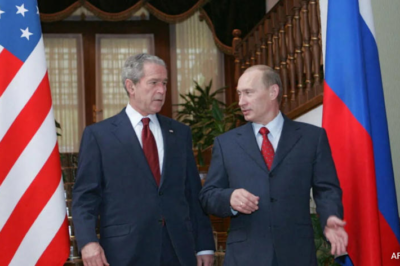
The documents, which cover conversations and meetings between 2001 and 2008, describe candid discussions in which Putin repeatedly expressed unease about Pakistan’s stability and its control over its atomic weapons. At their first face-to-face encounter on June 16, 2001, in Slovenia, the Russian leader reportedly told Bush that Pakistan was effectively “a junta with nuclear weapons” and questioned why Western governments were not more critical of Islamabad’s political rigidity and rising military influence
The two presidents, whose relationship would later be defined by both cooperation and conflict, did not dismiss these concerns. In private, Bush acknowledged that the situation made U.S. policymakers uneasy. Transcripts indicate that during a later Oval Office meeting in 2005, the pair discussed intelligence suggesting that uranium traced to Pakistan had been found in Iranian enrichment equipment, intensifying fears about proliferation beyond state control. Bush is reported to have said that such developments “made us nervous too,” underlining the gravity with which Washington viewed the possibility of nuclear material slipping into the wrong hands.
The records also touch on the notorious A.Q. Khan network, named for the Pakistani nuclear scientist whose illicit export of sensitive technology to foreign programs in Iran, Libya, and North Korea drew global alarm in the early 2000s. Bush told Putin that Pakistani authorities had detained key figures involved, but also admitted to frustration over incomplete information about the full scope of transfers.
Though Pakistan was a strategic partner for the United States in the years following the September 11 attacks, these newly released exchanges highlight a more complicated picture behind the scenes. Both Washington and Moscow appear to have viewed Pakistan’s nuclear stewardship with circumspection, driven by concerns that its arsenal could become vulnerable in times of internal instability and weak democratic governance.
The disclosures offer a rare window into high-level geopolitical discussions at a pivotal moment in post-Cold War history, revealing that even allies closely aligned on counter-terrorism had serious reservations about nuclear risks posed by third countries.




































Leave a Reply