
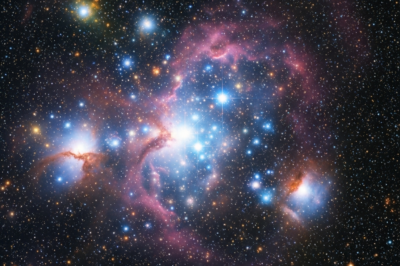
In the vast, silent expanse of the cosmos, few observatories have managed to capture the human imagination quite like the Hubble Space Telescope. For over three decades, this orbiting marvel has been our primary eye on the universe, peeling back layers of cosmic dust to reveal the raw, unfiltered beauty of the heavens. Recently, a breathtaking new portrait has emerged from Hubble’s archives, showcasing a staggering 10,000 individual stars shimmering within a fragment of the Large Magellanic Cloud (LMC). This image is not merely a pretty picture; it is a profound scientific document that offers a glimpse into the chaotic and creative processes that govern the birth and death of stars. By isolating such a dense population of celestial bodies in a single frame, NASA and the ESA have provided researchers and the public alike with a vivid reminder of the sheer scale of our galactic neighborhood. As we stand on the precipice of a new era of space exploration, these high-resolution observations serve as critical benchmarks for understanding how galaxies evolve and how the chemical elements necessary for life are forged in the hearts of distant suns.
The Galactic Neighborhood: Understanding the Large Magellanic Cloud
The Large Magellanic Cloud (LMC) is one of the closest neighbors to our own Milky Way galaxy, sitting approximately 163,000 light-years away. Despite its name, it is technically a satellite galaxy—a cosmic companion that dances in a gravitational embrace with our own. For centuries, it has been a fixture of the southern hemisphere’s night sky, appearing as a faint, blurry cloud to the naked eye. However, through the lens of the Hubble Space Telescope, this ‘cloud’ transforms into a bustling metropolis of stellar activity. The LMC is classified as an irregular galaxy, though it displays hints of a barred spiral structure, likely distorted by the immense gravitational pull of the Milky Way and its smaller companion, the Small Magellanic Cloud (SMC). This gravitational tug-of-war triggers massive waves of star formation, making the LMC a premier laboratory for astronomers. Because it is relatively close and positioned at an angle that allows for a clear, unobstructed view, it provides a ‘birds-eye view’ of galactic processes that are often obscured within our own disk by thick lanes of interstellar dust.
Technical Mastery: How Hubble Captured the Portrait
Capturing 10,000 stars in a single, coherent image requires more than just pointing a camera at the sky. The Hubble Space Telescope utilizes a suite of sophisticated instruments, most notably the Wide Field Camera 3 (WFC3) and the Advanced Camera for Surveys (ACS), to peer into the deep reaches of space. This specific portrait of the LMC was achieved through multi-wavelength observations, combining data from ultraviolet, visible, and near-infrared light. Each wavelength reveals a different layer of the galactic story. Ultraviolet light highlights the hottest, youngest stars, which burn with a fierce blue intensity and often live short, violent lives. Visible light provides the ‘true’ aesthetic of the cluster, showing the stars as they might appear to a human eye if it were significantly more powerful. Meanwhile, infrared light allows Hubble to peer through the veils of gas and dust that often shroud newborn stars, revealing the ‘nursery’ environments where stellar infants are coming to life. The precision required to resolve individual stars in such a crowded field is a testament to Hubble’s corrective optics and the stability of its platform in low Earth orbit, far above the blurring effects of Earth’s atmosphere.
A Stellar Census: Analyzing 10,000 Individual Stars
The sheer density of the stars in this portrait allows astronomers to conduct what is essentially a ‘stellar census.’ By measuring the brightness and color of each of the 10,000 stars, researchers can plot them on a Hertzsprung-Russell diagram—a fundamental tool in astrophysics that relates the luminosity of stars to their surface temperatures. This analysis reveals a diverse population: from massive blue giants that are tens of times the mass of our Sun to small, cool red dwarfs that will continue to glow for trillions of years. Within this specific field, Hubble has captured stars at various stages of their life cycles. Some are in their infancy, still surrounded by the remnants of the gas clouds from which they formed, while others are in their twilight years, swelling into red giants before they inevitably collapse. This snapshot provides a statistically significant sample size, allowing scientists to test models of stellar evolution with unprecedented accuracy. By understanding the distribution of star masses and ages in the LMC, we can better predict the future of our own galaxy and the frequency of events like supernovae, which enrich the universe with heavy metals.
The Role of Nebulae and Star-Forming Regions
The Large Magellanic Cloud is home to some of the most active star-forming regions in the local universe, most notably the Tarantula Nebula (30 Doradus). While the 10,000-star portrait focuses on a specific stellar field, it is heavily influenced by the surrounding environment of ionized gas and cosmic dust. These nebulae are the ‘foundries’ of the cosmos. High-energy radiation from massive stars pushes against the surrounding gas, creating shockwaves that trigger the collapse of new pockets of matter, thereby sparking the birth of the next generation of stars. This cycle of feedback is essential for galactic growth. The Hubble image showcases not just the stars themselves, but the subtle variations in the interstellar medium—the thin ‘soup’ of atoms and molecules that fills the space between star systems. Observations of these regions help astronomers understand the ‘metallicity’ of the LMC. In astronomy, ‘metals’ refer to any element heavier than hydrogen and helium. The LMC has a lower metallicity than the Milky Way, meaning it contains fewer heavy elements. This makes it a perfect surrogate for studying galaxies in the early universe, which also lacked the heavy elements produced by successive generations of stars.
Comparative Astronomy: Hubble vs. James Webb
The release of this iconic portrait comes at a time when the James Webb Space Telescope (JWST) is also making headlines with its deep-field infrared images. However, the Hubble Space Telescope remains indispensable. While JWST excels at looking back to the very first galaxies and peering through the densest dust clouds using long-wavelength infrared light, Hubble’s strength lies in its ability to capture high-resolution ultraviolet and visible light data. The two telescopes work in synergy; Hubble provides the ‘skeletal’ structure of the stellar populations, while JWST provides the ‘thermal’ map of the hidden gas and dust. For a region like the Large Magellanic Cloud, having data from both observatories is like having both an X-ray and an MRI of a patient. Hubble’s ability to resolve 10,000 individual stars in visible light ensures that we have a clear record of the visible stellar output, which is crucial for calibrating the infrared signatures seen by JWST. This multi-observatory approach is the gold standard of modern cosmology, ensuring that no detail, no matter how small or faint, goes unnoticed.
Scientific Implications: What This Means for Cosmology
The implications of this detailed LMC portrait extend far beyond the borders of this satellite galaxy. One of the most critical uses of LMC stellar data is the calibration of the ‘cosmic distance ladder.’ Astronomers use specific types of stars found in the LMC, such as Cepheid variables and RR Lyrae stars, as ‘standard candles’ to measure distances to other galaxies. If we can accurately determine the distance to the LMC by studying its individual stars, we can more accurately measure the expansion rate of the universe, known as the Hubble Constant. Currently, there is a discrepancy in the scientific community regarding the exact value of this constant—a problem known as the ‘Hubble Tension.’ Precise portraits like this one help refine our measurements of these standard candles, potentially solving one of the greatest mysteries in modern physics. Furthermore, studying the motion of these 10,000 stars allows researchers to map the distribution of dark matter within the LMC. Since dark matter does not emit light but does exert gravity, its presence can only be inferred by how it affects the orbits of the visible stars we see in Hubble’s images.
Conclusion: The Eternal Legacy of Hubble’s Vision
In conclusion, the ‘10,000 stars’ portrait of the Large Magellanic Cloud is more than a milestone for the Hubble Space Telescope; it is a bridge between our understanding of local stellar physics and the grand evolution of the universe. Each point of light in that image represents a sun, potentially hosting its own system of planets and moons, and contributing to the chemical complexity of its host galaxy. As Hubble continues to operate alongside newer missions, its legacy is cemented by its ability to turn the abstract concepts of astronomy into tangible, visible realities. This portrait reminds us that we live in a dynamic, ever-changing cosmos where the birth of a star 163,000 light-years away can provide the data needed to unlock the secrets of the Big Bang. As we continue to gaze into the heart of the LMC, we are not just looking at distant stars; we are looking at our own history and the fundamental laws that govern existence itself. The 10,000 stars of the Large Magellanic Cloud will continue to shine as a testament to human curiosity and our unwavering desire to map the final frontier.






































Leave a Reply