
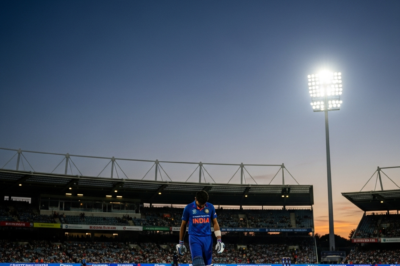
The second One Day International between India and England at the historic Sophia Gardens in Cardiff has provided a stark reality check for the Indian cricket team. In a performance that fluctuated between moments of brief resistance and long stretches of technical vulnerability, India was bundled out for 233 runs in exactly 44 overs. This score, significantly below par on a modern white-ball surface, has left the visitors with a mountain to climb in the second half of the match. The dismissal of the entire side with six overs still remaining in the innings highlights a catastrophic failure in game management and strike rotation. For England, the bowling performance was a masterclass in exploiting home conditions, utilizing the early morning moisture and the maritime breeze that often plays a decisive role at this Welsh venue. As the Indian players walked back to the pavilion, the atmosphere was one of introspection, while the English crowd sensed an opportunity to level or clinch the series depending on the current standings. This match marks a critical juncture in the tour, revealing deep-seated issues in India's middle-order stability and their approach to the middle overs against disciplined pace bowling.
The Historical Context of Sophia Gardens and Indian Performance
Sophia Gardens has never been an easy ground for visiting subcontinental sides. The pitch often offers a unique blend of bounce and lateral movement that requires batsmen to play late and close to the body. Historically, India has had mixed results at this venue, famously winning key matches during the Champions Trophy but also suffering collapses when the atmospheric conditions favor the bowlers. The significance of this 2nd ODI cannot be overstated; after the opening encounter, both teams were looking to establish dominance. For India, the goal was to post a total in excess of 300, a standard requirement in contemporary ODI cricket. However, the Cardiff deck had other plans. The grass cover, though light, was enough to keep the English seamers interested throughout the first twenty overs. England's captain, winning the toss and electing to field, demonstrated a keen understanding of the local climate, betting on his bowlers to extract early wickets. This decision proved prophetic as the Indian top order struggled to find their rhythm, leading to a sequence of events that saw the scoreboard ticking far slower than the required run rate.
The Top-Order Falter: A Study in Technical Vulnerability
The story of the 233 all-out began at the very top. India's opening pair, usually the bedrock of their success, found the going tough against the moving ball. The English opening bowlers maintained a tight line on off-stump, drying up the boundaries and forcing the batsmen to take risks. When the first wicket fell in the powerplay, it triggered a sense of unease that permeated through the dugout. The inability to survive the first ten overs without significant damage meant that the middle order was exposed much earlier than planned. Virat Kohli and Rohit Sharma, the pillars of the batting unit, were forced into a defensive shell, which in turn allowed the English spinners to settle into a rhythm during the middle overs. The dismissal of the key top-order batsmen before they could reach their respective half-centuries was the turning point. Each dismissal seemed to be a result of either a lapse in concentration or an exceptional delivery that exploited the slight unevenness of the bounce. By the time the 15th over concluded, India was already looking at a rebuilding phase rather than an acceleration phase, a tactical disadvantage they never truly recovered from.
England's Bowling Masterclass: Precision and Pressure
England's bowling attack deserves immense credit for their disciplined execution of plans. The pace battery, led by their senior pros, didn't just rely on speed but used subtle variations in pace and length to keep the Indian batters guessing. The usage of the short ball was particularly effective, not necessarily as a wicket-taking delivery every time, but as a tool to push the batsmen back and then follow it up with a fuller delivery that invited the drive. The spinners, playing their part to perfection, squeezed the life out of the middle overs. They bowled a stump-to-stump line, making it incredibly difficult for the likes of KL Rahul and Rishabh Pant to find the gaps. The pressure built up by dot balls eventually led to high-risk shots, which England's fielders were more than happy to capitalize on. The catching in the slip cordon and the ground fielding were of the highest standard, ensuring that every half-chance was converted into a wicket. This collective bowling effort ensured that India could never stitch together a partnership exceeding fifty runs, which is often the death knell for any batting side in the 50-over format.
The Middle-Order Muddle and the 44-Over Finish
Perhaps the most concerning aspect of the scorecard is that India was bowled out in 44 overs. In the modern era, leaving 36 deliveries on the table is an unpardonable sin. The middle and lower-order collapse showcased a lack of situational awareness. While the tail-enders cannot be expected to play like specialists, the recognized batsmen who remained at the crease failed to shield the tail or rotate the strike effectively. The transition from the 30th to the 40th over saw India lose wickets in clusters. Just when a partnership seemed to be brewing, a soft dismissal would occur, bringing the bowlers back into the game. This 'middle-order muddle' has been a recurring theme for India in overseas conditions, where the lack of a designated finisher or a stabilizing anchor becomes apparent. The 233-run total is a reflection of a side that struggled to adapt to the slowing nature of the pitch as the ball got older. Instead of grinding out a respectable 270 or 280, the team succumbed to the pressure of the dot balls, leading to a frantic finish where wickets were gifted to the opposition.
Statistical Analysis: Where the Game Was Lost
A deep dive into the statistics of the innings reveals the magnitude of the struggle. India's dot-ball percentage was alarmingly high, hovering around 55% for the duration of the innings. In a format where strike rotation is king, failing to score off more than half the deliveries faced is a recipe for disaster. Furthermore, the boundary count was significantly lower than the tournament average for Sophia Gardens. India managed only 18 boundaries and 2 sixes in 44 overs, indicating a lack of intent or an inability to pierce the field. On the other hand, England's bowlers maintained an average economy rate of under 5.3 runs per over, with their primary spinner conceding fewer than 4 runs per over. The data also shows that India lost three wickets for just 12 runs during the second powerplay, a period where they should have been setting the foundation for a late-overs charge. These numbers paint a picture of a batting unit that was technically outmatched and tactically outthought by a superior bowling performance on the day.
Future Implications: Lessons for the Series and Beyond
This result at Cardiff will have long-lasting implications for India's ODI strategy. With the World Cup cycles always in the back of the mind, the management must address the vulnerability against the moving ball. It is likely that we will see changes in the playing XI for the next match, perhaps with the inclusion of a more technically sound middle-order batsman or a bowling all-rounder who can provide depth. For England, this performance reaffirms their status as one of the most formidable white-ball units in the world, especially in their home conditions. They have shown that they do not need flat tracks to dominate; their bowlers are equally capable of defending small totals or restricting world-class lineups on sporting wickets. For India, the road ahead involves a lot of soul-searching. They must find a way to balance aggression with caution, ensuring that they bat out their full quota of 50 overs. The lessons learned at Sophia Gardens—ranging from shot selection to the importance of lower-order contributions—will be vital if they are to bounce back and remain competitive in the remainder of the series.
Conclusion: A Call for Tactical Evolution
In conclusion, India's total of 233 in 44 overs at the 2nd ODI in Cardiff is more than just a poor score; it is a symptom of a larger challenge facing the team in swinging conditions. While the bowlers might still fight to defend this total, the responsibility lies squarely on the shoulders of the batting unit. England has set the standard, and India must now rise to it. The match at Sophia Gardens serves as a poignant reminder that cricket is a game of fine margins, where a few overs of poor decision-making can undo months of preparation. As the series moves forward, the focus will be on whether India can adapt their technique and temperament to overcome the English challenge, or if Cardiff was a preview of a difficult summer ahead for the Men in Blue.





































Leave a Reply