
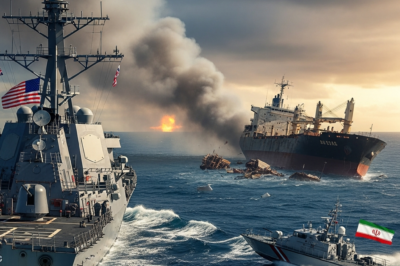
The geopolitical landscape of the Middle East has reached a perilous tipping point following a significant maritime engagement in the Red Sea. Reports emerging from Tehran and international observers indicate a sharp escalation in hostilities, with Iran formally accusing the United States of a gross violation of existing ceasefire protocols. The catalyst for this latest diplomatic and military crisis is a direct kinetic engagement involving a United States Navy destroyer and a commercial cargo vessel, which Iranian officials claim was an unprovoked act of aggression. As the shadow war between Iran and Israel increasingly spills into direct confrontation, this naval incident threatens to dismantle the fragile regional stability that diplomats have struggled to maintain. The global community now watches with bated breath as Iran promises a ‘swift and decisive response,’ raising the specter of a broader regional conflict that could engulf not only the Levant but the critical energy corridors of the Persian Gulf and the Bab el-Mandeb strait. This developing story represents more than just a naval skirmish; it is a manifestation of the deep-seated ideological and strategic friction between the Western coalition and the ‘Axis of Resistance’ led by the Islamic Republic.
The Inciting Incident: A Breakdown of the Naval Engagement
According to sources cited by The Hindu and various regional monitoring groups, the incident occurred in the early hours of the morning in the international waters of the Red Sea. A United States Arleigh Burke-class destroyer, patrolling as part of a maritime security task force, engaged a cargo vessel suspected of transporting prohibited materials. While the U.S. Central Command (CENTCOM) has historically maintained that its presence in the region is purely defensive—aimed at protecting commercial shipping from Houthi-led drone and missile attacks—Tehran paints a radically different picture. The Iranian Ministry of Foreign Affairs has characterized the strike on the cargo ship as a ‘terrorist act’ and a direct violation of maritime sovereignty. The ship in question, though flying a neutral flag, was reportedly linked to Iranian logistics networks. The physical damage to the vessel is said to be extensive, with reports of casualties among the merchant mariners on board. This specific kinetic action by a U.S. warship marks a departure from standard intercept-and-inspect protocols, suggesting either a high-stakes intelligence-led operation or a significant breakdown in communication between the naval forces operating in the congested waters of the Red Sea.
Tehran’s Response: Accusations of Ceasefire Violations
In a strongly worded statement released via state media, Iranian officials have declared that the United States has effectively torn up the informal ceasefire agreements that had been in place to prevent a direct Iran-U.S. confrontation. ‘The era of strategic patience is over,’ an IRGC (Islamic Revolutionary Guard Corps) spokesperson stated, emphasizing that the U.S. will soon face the consequences of its actions. The accusation of a ‘ceasefire breach’ is particularly significant. While no formal, signed peace treaty exists between Washington and Tehran, there have been long-standing back-channel understandings regarding the limits of military engagement, particularly concerning commercial assets and regional proxies. By targeting a ship that Tehran considers part of its vital economic and strategic interest, the U.S. is seen as having crossed a ‘red line.’ This shift in rhetoric from the Iranian leadership suggests that they are preparing their domestic audience and regional allies for a retaliatory strike, which could take many forms, ranging from cyberattacks on Western infrastructure to direct naval harassment or the activation of proxy cells in neighboring countries.
The Strategic Importance of the Red Sea and Maritime Corridors
To understand why a single ship being hit has caused such an uproar, one must look at the geography of the conflict. The Red Sea is one of the world’s most vital arteries for global trade, with nearly 15% of global maritime commerce passing through the Suez Canal. For Iran, the ability to project power in these waters is a key component of its ‘Forward Defense’ strategy. By maintaining a presence and supporting the Houthi movement in Yemen, Iran exerts significant leverage over global energy prices and Western economic security. The U.S. destroyer’s actions are viewed by Tehran as an attempt to re-establish Western hegemony over these waters and to break the Iranian-led blockade of Israeli-linked shipping. Conversely, from the perspective of the United States and its allies, the Red Sea must remain open and safe for all commercial traffic. The escalation here is a microcosm of the larger struggle for control over the global commons. Every missile fired and every ship struck adds to the insurance premiums of global shipping, slows down supply chains, and increases the risk of a miscalculation that could lead to a full-scale naval war.
Israel’s Role and the Widening Regional Conflict
While the immediate incident involves a U.S. destroyer, the context is inextricably linked to the ongoing war between Israel and Hamas, and by extension, the broader Iran-Israel rivalry. Israel has long accused Iran of using cargo ships to smuggle advanced weaponry to its proxies, including Hezbollah in Lebanon and the Houthis in Yemen. Israeli intelligence has likely been a key driver in the U.S. decision-making process regarding maritime intercepts. For Israel, the U.S. military presence in the Red Sea acts as a vital shield against Iranian encirclement. However, as Iran vows to respond, the primary target of that response may not be the U.S. Navy directly, but rather Israeli interests across the globe. This could include attacks on Israeli-owned shipping in the Indian Ocean, increased rocket fire from Lebanon, or even direct long-range drone strikes from Iranian soil. The ‘soon to respond’ threat from Tehran keeps the Israeli Defense Forces (IDF) on high alert, diverting resources from other fronts and complicating the regional security calculus.
The U.S. Military Stance: Defense vs. Aggression
The Pentagon maintains that its actions are consistent with international law and the right to self-defense. In recent months, U.S. destroyers in the Red Sea have intercepted hundreds of drones and missiles launched from Houthi-controlled areas of Yemen. The U.S. position is that any vessel facilitating these attacks or transporting the means to conduct them is a legitimate target for interception. However, the move from interception to a kinetic strike on a cargo ship represents a significant escalation. Analysts suggest that the U.S. may be shifting toward a more proactive ‘active defense’ posture, designed to deter Iran by showing that its assets are no longer untouchable. The risk, of course, is that such a posture invites the very escalation it seeks to prevent. Within the halls of power in Washington, there is a fierce debate between those who advocate for a ‘restoration of deterrence’ and those who fear that a direct conflict with Iran would be a catastrophic mistake, drawing the U.S. into another protracted Middle Eastern war at a time when its focus is needed in Eastern Europe and the Indo-Pacific.
Global Economic Implications and Future Outlook
The immediate impact of this escalation was felt in the global markets, with Brent crude oil prices seeing a sharp uptick following the news of the Iranian threat. The prospect of a ‘tanker war’ similar to the one seen during the 1980s Iran-Iraq conflict is a major concern for global economists. If Iran follows through on its threat to disrupt shipping or respond militarily, the costs of shipping goods from Asia to Europe could skyrocket, fueling global inflation. Furthermore, the diplomatic path to de-escalation appears increasingly narrow. With the U.S. and Iran lacking direct diplomatic channels, they rely on intermediaries like Oman or Qatar, but the speed of events on the ground is outpacing the pace of diplomacy. The ‘soon to respond’ warning suggests a window of days, not weeks. As we move forward, the key indicators to watch will be the movement of Iranian naval assets out of their home ports, the deployment of additional U.S. carrier strike groups to the region, and the rhetoric coming from the Supreme Leader’s office in Tehran. The world is witnessing a high-stakes game of brinkmanship where the margin for error is non-existent and the consequences of a mistake are global in scale.




































Leave a Reply