
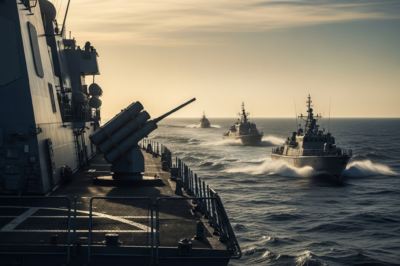
The geopolitical landscape of the Middle East has been thrust into a state of high-alert following a dramatic and aggressive directive from former U.S. President Donald Trump, who has reportedly ordered the United States Navy to ‘shoot down and destroy’ any Iranian small boats found to be harassing American vessels or laying mines within the critical waters of the Strait of Hormuz. This development represents a significant departure from standard maritime engagement protocols and underscores the rapidly deteriorating security situation involving the United States, Israel, and the Islamic Republic of Iran. The Strait of Hormuz, a narrow waterway through which nearly one-fifth of the world’s global petroleum consumption passes, has once again become the epicenter of a potential military confrontation that could have catastrophic consequences for global energy markets and regional stability. This latest move comes at a time when Israel and Iran are already locked in a shadow war that has increasingly spilled over into direct kinetic actions, raising fears of a broader conflict that could engulf the entire region.
The Strategic Significance of the Strait of Hormuz
To understand the gravity of this directive, one must first appreciate the geographical and economic importance of the Strait of Hormuz. Linking the Persian Gulf with the Gulf of Oman and the Arabian Sea, the strait is only 21 miles wide at its narrowest point. Despite its diminutive size, it serves as the world’s most important oil transit chokepoint. According to the U.S. Energy Information Administration (EIA), more than 20 million barrels of oil flow through this waterway every single day. Any disruption to this flow—whether through blockades, mining, or active combat—would send oil prices skyrocketing, potentially plunging the global economy into a recession. Historically, the strait has been a flashpoint for international tension, most notably during the ‘Tanker War’ phase of the Iran-Iraq War in the 1980s, when both nations targeted commercial shipping to cripple each other’s economies. Today, the Iranian Revolutionary Guard Corps (IRGC) Navy utilizes the geography of the strait to its advantage, employing ‘swarming’ tactics with small, fast-attack craft that are difficult for traditional naval destroyers to track and engage effectively.
Analyzing the ‘Shoot and Kill’ Directive: A Shift in Engagement
The directive issued by Trump marks a pivot from a defensive or ‘proportional response’ posture to a more proactive and lethal engagement strategy. Traditionally, U.S. Navy vessels operating in the Persian Gulf follow strict Rules of Engagement (ROE) that emphasize de-escalation and the use of non-lethal warnings before employing deadly force. However, the reported order to ‘shoot and kill’ or ‘destroy’ Iranian boats suspected of laying mines suggests a move toward preemptive action. Proponents of this harder line argue that Iran has long exploited U.S. restraint to harass shipping and plant naval mines with impunity. By authorizing lethal force at the first sign of hostile intent—such as the deployment of mines—the U.S. aims to restore a level of deterrence that it believes has been eroded over recent years. Critics, however, warn that such a directive increases the risk of a miscalculation. In the crowded and high-tension environment of the Strait, a misinterpreted maneuver by a small boat could trigger a lethal U.S. response, leading to a cycle of escalation that neither side may be able to easily contain.
The IRGC Navy and Asymmetric Maritime Warfare
The Iranian approach to maritime security is rooted in the doctrine of asymmetric warfare. Lacking the heavy industrial capacity to compete with the U.S. Navy’s carrier strike groups, the IRGC Navy has instead invested heavily in thousands of small, fast, and maneuverable boats. These vessels are often equipped with heavy machine guns, rocket launchers, and, most crucially, the capability to deploy sophisticated naval mines. These mines are a significant threat because they are relatively cheap to produce, easy to hide, and can cause catastrophic damage to both military and commercial shipping. The tactic of ‘swarming’ involves using dozens of these small boats to surround a larger vessel, overwhelming its defensive systems through sheer numbers and speed. By ordering the Navy to target these specific vessels, the U.S. is directly challenging Iran’s primary tool for regional power projection and maritime denial. This creates a volatile ‘cat and mouse’ game where the stakes involve not just the lives of sailors but the stability of the global energy supply.
Israel’s Shadow War and the Iranian Nuclear Threat
The timing of this directive cannot be separated from the ongoing ‘shadow war’ between Israel and Iran. Israel has long viewed Iran’s nuclear program and its network of regional proxies—including Hezbollah in Lebanon and various militias in Iraq and Syria—as an existential threat. In recent months, there have been a series of mysterious explosions at Iranian nuclear facilities and cyberattacks on Iranian infrastructure, which Tehran has blamed on Israeli intelligence agencies. Conversely, Israel has accused Iran of targeting Israeli-owned commercial vessels in the Gulf of Oman. The U.S. directive serves to bolster the Israeli position, signaling that the United States is willing to use military force to curtail Iranian aggression on the high seas. This alignment between Washington and Jerusalem creates a formidable front against Tehran, but it also means that any conflict initiated in the Strait of Hormuz would likely see immediate Israeli involvement, either through intelligence sharing or direct military action against Iranian interests elsewhere in the region.
Economic Repercussions and Global Market Sensitivity
The global economy remains incredibly sensitive to any threats regarding the Strait of Hormuz. Upon the news of the directive, energy analysts noted an immediate uptick in oil futures. The concern is not just the physical destruction of tankers, but the skyrocketing costs of maritime insurance and the potential for a complete halt in transit. If the Strait were to be closed, even for a short period, there is no viable alternative for the volume of oil that currently passes through it. While some pipelines exist across Saudi Arabia and the UAE, they do not have the capacity to handle the 20 million barrels per day currently moving by sea. Furthermore, the psychological impact on the markets can be just as damaging as a physical blockade. Investors often price in the ‘geopolitical risk premium,’ and a directive to ‘shoot and kill’ significantly raises that premium, leading to higher fuel prices for consumers worldwide and increased operational costs for global shipping industries.
Future Outlook: Diplomacy or Kinetic Conflict?
As the international community watches with bated breath, the path forward remains uncertain. There are two primary schools of thought regarding the outcome of this escalation. The first is that the credible threat of lethal force will force Iran to scale back its provocative actions in the Strait, leading to a period of ‘tense peace’ where both sides avoid direct confrontation. The second, more pessimistic view, is that we are witnessing the opening salvos of a direct military conflict. With diplomatic channels between Washington and Tehran largely dormant, there is very little ‘off-ramp’ for de-escalation. The international community, led by European powers and regional players like Oman, continues to call for restraint, but as the rhetoric sharpens and the rules of engagement shift, the margin for error has become razor-thin. The coming weeks will be critical in determining whether the Strait of Hormuz remains a vital artery for global commerce or becomes the graveyard of modern diplomacy.
In conclusion, the order to the U.S. Navy to engage Iranian small boats marks a definitive and dangerous new chapter in Middle Eastern geopolitics. It reflects a world where deterrence is sought through the threat of immediate and lethal action, and where the strategic value of a single waterway can dictate the economic health of the entire planet. As Israel and Iran continue their regional tug-of-war, the U.S. Navy stands at the ready, with its finger on the trigger, waiting to see if Tehran will heed the warning or test the resolve of the American military.




































Leave a Reply