
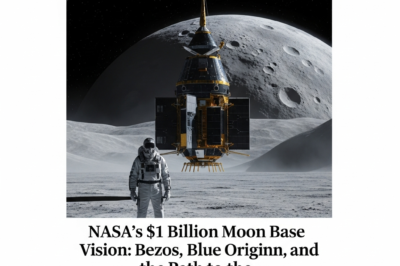
For more than half a century, the lunar surface has remained a desolate, silent monument to the triumphs of the Apollo era. However, the tides of space exploration are shifting with unprecedented velocity. NASA’s Artemis program, once seen as a series of aspirational milestones, has now solidified into a concrete, multibillion-dollar roadmap for a permanent human settlement. At the heart of this transformation is a pivotal partnership with Jeff Bezos’ Blue Origin, a deal that effectively greenlights the construction of a lunar base and sets a definitive target for sustained human presence by 2032. This $1 billion initial investment into the base architecture represents more than just a line item in a federal budget; it signifies the birth of a cislunar economy and the first true step toward becoming a multi-planetary species. The collaboration between the public sector and private aerospace titans is no longer a peripheral experiment; it is the primary engine driving the next great leap for mankind.
The Blue Origin Factor: Jeff Bezos Joins the Lunar High Table
The recent announcement that Blue Origin has secured a massive contract to develop a human landing system (HLS) for the Artemis missions has sent shockwaves through the aerospace industry. While SpaceX had previously dominated the headlines with its Starship contract, the inclusion of Jeff Bezos’ firm ensures a redundant and competitive ecosystem for lunar access. The $1 billion earmarked for the initial lunar base infrastructure is deeply intertwined with Blue Origin’s Blue Moon lander, a massive vehicle designed to deliver heavy payloads to the lunar south pole. This partnership is strategic; NASA is leveraging the vertical integration and private capital of Blue Origin to accelerate timelines that were previously considered impossible. The Blue Moon lander is expected to provide the heavy-lift capabilities necessary to transport pressurized habitats, scientific equipment, and the foundational components of a lunar power grid. By diversifying its partners, NASA is mitigating the risks of technical failure, ensuring that if one path encounters a hurdle, the mission to establish a base by 2032 remains on track.
Engineering the Impossible: Building Habitats in Lunar Regolith
Constructing a base on the Moon is an engineering challenge that dwarfs anything previously attempted on Earth. The environment is unapologetically hostile, characterized by extreme temperature fluctuations, constant bombardment from micrometeoroids, and high-energy cosmic radiation. To overcome these obstacles, NASA and its partners are looking toward revolutionary technologies such as 3D printing and in-situ resource utilization (ISRU). The vision for 2032 involves using lunar soil, or regolith, as a primary building material. By sintering regolith into solid structures using solar-powered microwaves or lasers, robotic excavators can create protective shells for pressurized habitats. This approach eliminates the need to transport heavy concrete or steel from Earth, which costs tens of thousands of dollars per kilogram. These structures will be designed to withstand the two-week-long lunar nights, where temperatures plummet to minus 280 degrees Fahrenheit, requiring advanced thermal management systems and robust energy storage solutions, likely involving regenerative fuel cells and small modular nuclear reactors.
The Artemis Accord and Global Geopolitics
The establishment of a $1 billion lunar base is not occurring in a vacuum; it is a centerpiece of international diplomacy and competition. The Artemis Accords, a set of principles designed to govern the civil exploration and use of outer space, have been signed by dozens of nations, creating a coalition of allies committed to transparency and peaceful cooperation. However, the move to establish a permanent base by 2032 is also a response to the rapid advancements of the China-Russia International Lunar Research Station (ILRS) project. The lunar south pole has become the most valuable real estate in the solar system due to its unique lighting conditions and the presence of water ice. The nation or coalition that first establishes a permanent presence will likely set the standards for lunar property rights, mining regulations, and the management of orbital traffic. NASA’s deal with Bezos ensures that the United States and its partners remain at the forefront of this high-stakes geopolitical race, securing democratic values in the final frontier.
Sustaining Life: Water Ice and the South Pole Strategy
The primary reason for targeting 2032 for a permanent base is the discovery of water ice in the permanently shadowed regions (PSRs) of the lunar south pole, specifically around the Shackleton Crater. Water is the ‘oil’ of the space age. It can be broken down into oxygen for breathing and hydrogen for rocket fuel. The $1 billion investment covers the development of robotic prospecting missions that will map these ice deposits with surgical precision. If successful, the lunar base will serve as a fueling station for deep-space missions. Instead of launching a fully fueled rocket from Earth’s deep gravity well, future missions to Mars could launch ‘light’ and refuel at the Moon. This ‘living off the land’ philosophy is the only way to make space exploration economically sustainable. The base will also feature closed-loop life support systems, where every drop of sweat and every breath of CO2 is recycled with near-perfect efficiency, a technology that will eventually have profound applications for water scarcity issues here on Earth.
The Economic Frontier: Towards a Multi-Billion Dollar Space Economy
While the initial cost of the base is significant, the long-term economic implications are staggering. The involvement of Blue Origin and SpaceX suggests a future where the Moon is not just a scientific outpost, but a commercial hub. By 2032, we may see the beginnings of lunar tourism, though initially limited to the ultra-wealthy, and the mining of Rare Earth Elements (REEs) or Helium-3, which is a potential fuel for future fusion reactors. The infrastructure built for the NASA base—communications relays, landing pads, and navigation beacons—will provide the ‘utilities’ that private companies can pay to use. This mirrors the development of the American West, where the government provided the railroad infrastructure, and the private sector followed to build cities and commerce. The $1 billion is the seed money for an industry that Morgan Stanley predicts could be worth over $1 trillion by 2040. The transition from government-led exploration to a commercial ecosystem is the ultimate goal of the Artemis-Bezos partnership.
2032 and Beyond: A Stepping Stone to the Red Planet
It is vital to understand that the Moon is not the final destination. For NASA, the 2032 lunar base is a critical testbed for the ‘Moon to Mars’ initiative. The technologies being developed—long-duration life support, radiation shielding, and autonomous construction—are exactly what will be required to survive on the Martian surface. Mars is months away, while the Moon is only three days away. If something goes wrong at the lunar base, there is a chance for rescue or resupply; on Mars, astronauts are on their own. By spending the 2030s mastering the art of living on another world, NASA ensures that when the first humans set foot on Mars in the late 2030s or early 2040s, they do so with a decade of lunar experience behind them. The $1 billion base is the classroom where we will learn how to thrive in the cosmos, turning the Apollo legacy into a permanent human future among the stars.







































Leave a Reply