
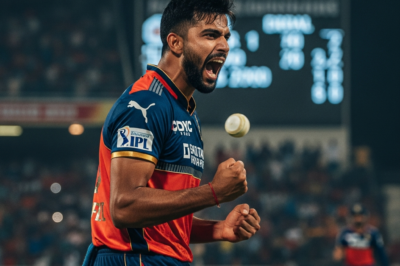
The M. Chinnaswamy Stadium in Bengaluru witnessed a cricketing exhibition of the highest order as the Indian Premier League (IPL) 2026 reached its fever pitch during Qualifier 1. In a clash that felt more like a gladiator battle than a cricket match, the Royal Challengers Bengaluru (RCB), led by their talismanic new captain Rajat Patidar, dismantled the Gujarat Titans (GT) bowling attack to post a staggering 254/5 in their allotted 20 overs. This score not only sets a new benchmark for high-stakes playoff matches but also cements Patidar’s legacy as a leader who leads from the front. The atmosphere was electric, with a sea of red and gold engulfing the stands, creating a deafening roar that seemed to rattle even the most seasoned GT veterans. As the sun set over the Garden City, the fireworks on the pitch matched the celebrations in the rafters, signaling a potential shift in the hierarchy of the IPL as RCB inches closer to that elusive maiden title.
The Patidar Masterclass: A Captain’s Knock for the Ages
When Rajat Patidar took over the captaincy earlier this season, many skeptics questioned whether the pressure of leadership would stifle his natural stroke-play. Tonight, he silenced every critic with a performance that will be discussed for decades. Opening the innings alongside the seasoned Virat Kohli, Patidar took the initiative from the very first ball. While Kohli played the role of the anchor, Patidar was the aggressor, utilizing his sublime timing and wrists to find gaps that didn’t seem to exist. His century, coming off just 48 balls, featured 12 massive sixes and 8 boundaries. What made this innings particularly special was the tactical brilliance behind it; Patidar targeted the shorter boundaries with surgical precision, forcing Gujarat Titans captain Shubman Gill to frequently shuffle his fielders to no avail. By the time he was eventually dismissed in the 18th over, the damage was done, and the foundation for a historic total was firmly laid.
The M. Chinnaswamy Cauldron: Conditions and Atmosphere
The venue for this Qualifier 1, the M. Chinnaswamy Stadium, has always been a paradise for batters, but the 2026 surface seemed even more conducive to run-scoring. With a lightning-fast outfield and a pitch that offered zero assistance to the spinners, the bowlers were essentially lambs to the slaughter. The humidity levels remained moderate, ensuring that the ball didn’t swing significantly after the first two overs. However, the real story was the crowd. The ’12th Man Army’ was in full voice, creating a psychological barrier for the Gujarat Titans. Every dot ball was celebrated like a wicket, and every boundary felt like a nail in the opposition’s coffin. The sheer noise levels were recorded at near-record highs, proving once again why Bengaluru remains one of the most intimidating venues for any visiting team in the IPL circuit.
GT’s Bowling Woes: Where Did Rashid and Shami Go Wrong?
For a team that has historically prided itself on its bowling unit, the Gujarat Titans looked surprisingly toothless. Rashid Khan, usually the go-to man for breakthroughs, found himself under immense pressure early on as Patidar and Green took a liking to his leg-spin. Rashid finished his four overs with an uncharacteristic economy rate of 12.5, failing to find the drift that usually makes him a nightmare for right-handers. Similarly, Mohammed Shami struggled with his lengths in the death overs, as Will Jacks and Cameron Green exploited his tendency to bowl full-tosses when under duress. The Titans’ tactical decision to play three frontline seamers on a pitch that demanded variety and pace changes backfired significantly. The lack of a secondary spin option meant that once Rashid was neutralized, there was no plan B to stem the flow of runs.
The Supporting Cast: Jacks and Green’s Power Hitting
While Patidar was the undisputed star, the contributions of Will Jacks and Cameron Green cannot be overlooked. Coming in at number three and four respectively, the duo maintained the momentum generated during the powerplay. Jacks played a blistering cameo of 42 runs from 15 balls, including three consecutive sixes off Noor Ahmad, which pushed the run rate past 12 per over. Cameron Green then took over the finishing duties, showcasing his brute strength by clearing the stadium roof on two separate occasions. Their ability to rotate the strike and punish even marginally loose deliveries ensured that RCB didn’t lose momentum during the middle overs, a phase where they have traditionally struggled in previous seasons. This collective batting effort highlighted the depth and balance of the 2026 RCB roster.
Strategic Shifts: The Evolution of RCB under Captain Patidar
The 2026 season has seen a marked shift in RCB’s strategic approach. Gone are the days of over-reliance on one or two star players. Under Patidar’s leadership, the team has embraced a ‘total cricket’ philosophy where every player in the top seven is encouraged to play with a strike rate of 150+. This aggressive mindset was evident today as RCB reached their 100-run mark in just 7.4 overs. Furthermore, the promotion of local talent and the integration of international power-hitters have created a synergistic effect that makes them arguably the most dangerous batting lineup in the tournament. The tactical decision to keep Dinesh Karthik as a finishing consultant has also paid dividends, as the younger batters displayed a sense of calm during the high-pressure moments of the death overs.
Statistical Breakdown and Historical Context
A score of 254/5 is not just a high score; it is the third-highest total in the history of the Indian Premier League and the highest ever in a playoff match. To put this into perspective, the previous record for a Qualifier was 226. RCB managed to maintain a run rate of 12.7 throughout the innings, with 68% of their runs coming in boundaries. The 152-run partnership between Patidar and Kohli for the first wicket is also a new record for the franchise in knockouts. For GT, this represents the most runs they have ever conceded in a single match since their inception in 2022. These statistics underscore the magnitude of the task ahead for Shubman Gill’s men as they attempt a chase that would require a miracle of biblical proportions.
Road to the Final: The Implications of This Score
With a target of 255 to chase, the Gujarat Titans find themselves in uncharted territory. While they possess a formidable batting lineup including Gill, Sai Sudharsan, and David Miller, the sheer weight of runs often creates a scoreboard pressure that leads to early wickets. For RCB, this performance serves as a massive confidence booster. After years of ‘near misses’ and ‘what ifs,’ the team looks more prepared than ever to go all the way. The winner of this match heads straight to the final in Mumbai, while the loser will have to face the winner of the Eliminator in Qualifier 2. Given the current form and the psychological edge gained from this massive total, RCB fans have every reason to believe that ‘Ee Sala Cup Namde’ (This year the cup is ours) might finally transition from a hopeful slogan to a reality.
Conclusion: A New Era for Royal Challengers Bengaluru
The innings break of Qualifier 1 marks a potential turning point in the history of the Royal Challengers Bengaluru. By posting 254/5, they haven’t just put themselves in a winning position; they have made a statement to the entire league. Captain Rajat Patidar has proven that he belongs in the upper echelon of Indian cricket leadership, blending raw talent with tactical maturity. Whether Gujarat Titans can pull off the greatest chase in T20 history remains to be seen, but for now, the night belongs to Bengaluru. The energy at the Chinnaswamy is a testament to the enduring passion of the fans, and if the bowlers can defend this total with even half the intensity the batters showed, the RCB squad will be booking their flights to Mumbai with their heads held high.




































Leave a Reply