
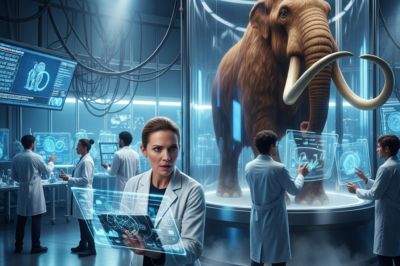
The Dawn of De-Extinction: A Visionary’s Quest
For millennia, the woolly mammoth has been a symbol of a lost world, a majestic beast that roamed the frozen reaches of the northern hemisphere until its final disappearance from Wrangel Island approximately 4,000 years ago. However, the boundary between the past and the future is beginning to blur. As recently highlighted in a profound profile by The Times, Ben Lamm, a serial tech entrepreneur, has partnered with world-renowned geneticist George Church to achieve what was once considered the realm of science fiction: the de-extinction of the woolly mammoth. This is not merely a hobbyist’s endeavor or a cinematic stunt; it is a billion-dollar scientific crusade spearheaded by Colossal Biosciences, a company that aims to revolutionize biotechnology, conservation, and climate science simultaneously. The mission represents one of the most ambitious biological projects in human history, challenging our understanding of evolution and our responsibility to the planet’s biodiversity.
The core of this mission lies in the intersection of advanced CRISPR gene-editing technology and ecological restoration. By reintroducing a cold-resistant proxy of the mammoth to the Arctic tundra, Lamm and his team believe they can revitalize a dying ecosystem. The project has sparked a global conversation, drawing both intense fascination and sharp ethical criticism. To understand the magnitude of this undertaking, one must look beyond the spectacle of a prehistoric giant and into the intricate web of genetic engineering, venture capital, and environmental philosophy that fuels Colossal’s engine. This article explores the man, the technology, and the massive implications of bringing a ghost back to life.
The Architect of the Impossible: Who is Ben Lamm?
Ben Lamm is not a traditional biologist. His background is rooted in the fast-paced world of technology and software, having successfully exited multiple startups before turning his gaze toward the ultimate ‘moonshot.’ Lamm’s approach to de-extinction is that of a tech disruptor: aggressive, well-funded, and focused on rapid iteration. When he met George Church—a man often described as the ‘founding father of genomics’—the synergy was immediate. Church had the scientific blueprint; Lamm had the operational expertise and the ability to attract the massive capital required to fund a laboratory that operates on the cutting edge of what is physically possible.
Lamm’s philosophy is built on the idea that humanity has a moral obligation to fix the ecological damage it has caused. He views the woolly mammoth not as a trophy, but as a functional tool for environmental stability. Under his leadership, Colossal has secured funding from high-profile investors, including billionaire Peter Thiel, Paris Hilton, and various venture capital firms specialized in deep tech. This influx of cash has allowed the company to hire dozens of world-class scientists and establish state-of-the-art facilities that rival the most prestigious academic institutions. Lamm’s mission is clear: to prove that extinction is not necessarily permanent and that technology can be the savior of the natural world.
The Science of Resurrection: CRISPR and the Asian Elephant
The primary technical hurdle in bringing back the mammoth is the fact that DNA degrades over time. While scientists have recovered remarkably well-preserved specimens from the Siberian permafrost, the genetic material is fragmented into millions of tiny pieces. You cannot simply ‘clone’ a mammoth from a frozen cell. Instead, the team at Colossal is using the Asian Elephant—the mammoth’s closest living relative, sharing 99.6% of its DNA—as a template. By using CRISPR-Cas9, the revolutionary gene-editing tool, scientists can precisely insert specific mammoth traits into the elephant genome.
These traits are not chosen at random. The team is focusing on functional phenotypes that would allow the animal to thrive in sub-zero temperatures. These include the growth of a thick, shaggy coat of hair, smaller ears to prevent heat loss, increased subcutaneous fat for insulation, and specialized hemoglobin that efficiently transports oxygen in freezing climates. The resulting organism will not be a 100% pure woolly mammoth, but rather a ‘functional proxy’—a hybrid that looks, acts, and survives like its ancient ancestors. This process involves sophisticated cellular reprogramming, where skin cells from an Asian Elephant are turned into pluripotent stem cells, edited, and then developed into embryos. The complexity of this task cannot be overstated; it requires overcoming the biological barriers of a 22-month gestation period and the development of artificial wombs to avoid the ethical complications of using endangered Asian elephants as surrogates.
Ecological Restoration: Can Mammoths Save the Tundra?
Perhaps the most compelling argument for the return of the mammoth is its potential impact on climate change. The Arctic tundra is home to vast amounts of permafrost, which contains double the amount of carbon currently in the atmosphere. As the planet warms, this permafrost melts, releasing methane and CO2 in a dangerous feedback loop. Ecologists Sergei and Nikita Zimov, who manage ‘Pleistocene Park’ in Siberia, have long argued that the loss of megafauna led to the transformation of the Arctic from a productive grassland into a mossy, insulating wetland that accelerates warming.
Woolly mammoths were the ‘engineers’ of this ecosystem. By trampling through the deep snow, they exposed the ground to the frigid air, keeping the permafrost much colder than it would be under a thick, insulating blanket of snow. Furthermore, their grazing habits promoted the growth of hardy grasses, which reflect more sunlight than dark shrubs and forests (the albedo effect). Lamm’s mission posits that reintroducing thousands of these giants could functionally reset the Arctic clock, slowing down the melting of permafrost and sequestering gigatons of carbon. This ‘rewilding’ strategy suggests that the mammoth is not just a biological curiosity, but a crucial piece of infrastructure for a cooling planet.
The Ethical Minefield: Playing God or Practicing Stewardship?
As with any project of this scale, the ethical concerns are profound. Critics argue that spending hundreds of millions of dollars on de-extinction is a distraction from the urgent need to protect existing endangered species. There are fears that if we believe we can ‘undo’ extinction, our motivation to preserve current biodiversity will dwindle. Furthermore, bioethicists raise questions about the welfare of the animals themselves. Mammoths were highly social creatures; what kind of life would the first ‘proxy’ mammoth have, being the only one of its kind in a modern world? Would it be a lonely experiment or a thriving member of a new herd?
There is also the question of ecological impact. The world has changed significantly in the 4,000 years since mammoths went extinct. Could their reintroduction cause unforeseen damage to existing Arctic species or traditional indigenous ways of life? Lamm and Colossal address these concerns by emphasizing that the technologies developed for the mammoth project—such as artificial wombs and advanced genetic mapping—are already being shared with conservationists to help save the Asian and African elephants from their own impending extinction. They argue that the ‘mammoth’ is the flagship project that funds and accelerates the development of a toolkit for all of conservation biology.
The Timeline to Tomorrow: When Will We See a Calf?
While the project sounds like a distant dream, Colossal has set remarkably ambitious timelines. Ben Lamm has publicly stated that the company aims to produce its first mammoth-elephant hybrid calves by 2027 or 2028. This timeline is incredibly aggressive, considering the biological constraints of elephant reproduction. However, the company continues to hit its milestones, recently announcing the successful creation of induced pluripotent stem cells for elephants, a feat that had eluded scientists for decades. This breakthrough is a critical step in the path toward generating the embryos that will eventually become the new mammoths.
The plan involves establishing ‘rewilding’ zones where these animals can be monitored and studied as they are integrated into the environment. These zones will likely be located in remote areas of the Arctic, far from human population centers, allowing the animals to develop natural behaviors. If successful, the mammoth project will serve as a blueprint for other de-extinction efforts. Colossal has already announced plans to bring back the Dodo bird and the Thylacine (Tasmanian Tiger), suggesting that we are entering an era where the catalog of life is no longer a one-way street.
Conclusion: A New Chapter for Humanity and Nature
The mission to bring back the woolly mammoth is a testament to the heights of human ingenuity and the depth of our desire to reconcile with the natural world. Ben Lamm’s journey, as documented by The Times, is not just about a single species; it is about redefining what is possible in the age of the Anthropocene. Whether one views it as a heroic effort to save the climate or a hubristic attempt to play God, there is no denying that the work being done at Colossal Biosciences will change the face of biology forever. As we stand on the precipice of this new frontier, we are forced to ask ourselves: what kind of ancestors do we want to be? If we have the power to bring back what was lost, do we have the wisdom to manage it? The return of the mammoth may well be the first step toward a future where we don’t just witness the decline of nature, but actively participate in its rebirth.






































Leave a Reply