
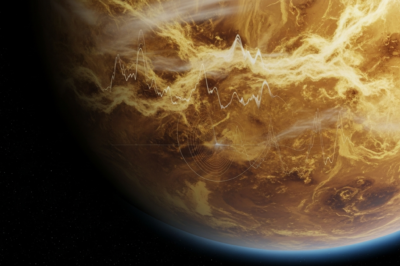
Venus, often referred to as Earth’s ‘evil twin,’ has once again surprised the scientific community. According to a recent report on astrobiology.com, researchers have identified significant ‘jumps and waves’ within the planet’s thick, toxic atmosphere. These atmospheric disturbances provide a window into the complex dynamics of a world where lead-melting temperatures and high-pressure winds are the norm. This discovery highlights the extreme energy transfer occurring within the Venusian climate system, which continues to baffle researchers with its intensity.
Understanding Atmospheric Gravity Waves on Venus
The phenomenon described as ‘jumps and waves’ refers to massive atmospheric gravity waves that ripple through the clouds of Venus. Unlike gravitational waves in spacetime, these are physical movements of gas and pressure triggered by the planet’s unique topography and extreme heat. Data suggests these waves can span thousands of kilometers, influencing the rotation of the atmosphere itself—a process known as super-rotation, where the winds move much faster than the planet’s solid surface. These jumps are essentially sudden shifts in atmospheric pressure that create a turbulent environment unlike anything seen on Earth.
The Intersection of Planetary Weather and Astrobiology
While Venus is currently a hellish landscape, understanding its atmospheric movement is crucial for the field of astrobiology. These jumps in pressure and temperature affect how chemicals and potentially organic compounds are distributed within the clouds. Some scientists believe that temperate zones within the Venusian cloud decks could potentially harbor microbial life. By mapping these waves, researchers can better predict the long-term climate evolution of Venus and, by extension, Earth. This discovery serves as a vital benchmark for upcoming missions like NASA’s DAVINCI and ESA’s EnVision, which aim to probe the depths of the Venusian clouds more closely than ever before.
Ultimately, these findings emphasize that Venus is far from a stagnant world. It is a dynamic, evolving environment that continues to challenge our models of planetary science, reminding us that even our closest neighbors still hold profound secrets that could reshape our understanding of the universe.





































Leave a Reply