
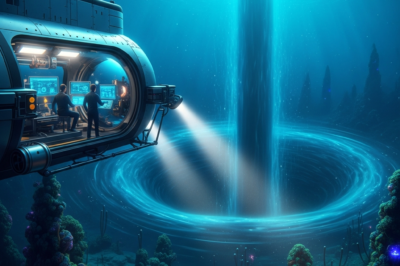
Deep beneath the waves of the Indian Ocean lies a massive anomaly—a gravity hole where the Earth’s pull is significantly weaker than anywhere else on the planet. For decades, scientists have been baffled by this phenomenon, but a groundbreaking study from the Indian Institute of Science (IISc) may have finally unlocked the secrets of the Indian Ocean Geoid Low (IOGL). This gravitational dip has long been one of the most significant mysteries in geophysics, affecting how we understand the planet’s internal structure.
The Science Behind the Indian Ocean Geoid Low
The IOGL covers more than 3 million square kilometers and sits roughly 700 miles beneath the ocean’s surface. In this region, the sea level is nearly 100 meters lower than the global average because the lack of gravitational pull fails to draw water toward it. Researchers Debanjan Pal and Attreyee Ghosh used advanced supercomputers to simulate the last 140 million years of tectonic plate movements. Their findings suggest that the hole is the result of a specific mantle structure formed by the remnants of an ancient ocean that once separated the supercontinents of Gondwana and Laurasia.
Mantle Plumes and the Ghost of the Tethys Ocean
The study points towards mantle plumes—upwellings of abnormally hot rock within the Earth’s mantle—as the primary cause. These plumes are believed to have been generated by the subduction of the Tethys Ocean plate into the mantle millions of years ago. As the ancient plate sank deep into the Earth, it pushed hot material upward under the Indian Ocean, creating a low-density region that manifests as a gravitational deficit. This discovery provides a definitive link between deep-earth dynamics and surface-level gravitational anomalies that have puzzled the scientific community since 1948.
This breakthrough not only solves a long-standing geological puzzle but also enhances our understanding of how the Earth’s interior continues to shape the planet’s physical geography. As researchers refine these models, we gain a clearer picture of the violent and transformative history of our world’s oceans and the hidden forces deep beneath the crust.







































Leave a Reply