
Introduction to a New Era of Physics
In a milestone that has sent shockwaves through the global scientific community, researchers have successfully observed a quantum effect that was previously confined to the pages of theoretical physics journals. This discovery, recently highlighted by The Debrief, marks a pivotal moment in our understanding of the subatomic world. For decades, the phenomenon remained elusive, existing only as a mathematical possibility within the complex frameworks of quantum mechanics. The successful validation of this theory not only proves the robustness of our current physical models but also opens a gateway to technologies once considered the realm of science fiction. Quantum mechanics, the branch of physics dealing with the behavior of matter and energy at the scale of atoms and subatomic particles, has always been defined by its counterintuitive nature. However, the transition from theoretical abstraction to empirical evidence is rare and profound. This breakthrough serves as a testament to human ingenuity and the relentless pursuit of knowledge, bridging the gap between what we suspect about the universe and what we can actually prove through rigorous experimentation. As we stand on the precipice of this new discovery, the implications for computing, communication, and material science are nothing short of revolutionary, promising to redefine the technological landscape of the 21st century and beyond.
The Theoretical Foundation and Historical Context
To appreciate the magnitude of this breakthrough, one must look back at the history of quantum theory. In the early 20th century, pioneers like Max Planck, Albert Einstein, and Werner Heisenberg began to dismantle the classical Newtonian view of the universe. They proposed that at the smallest scales, energy is not continuous but exists in discrete packets called quanta. Over the following decades, theorists predicted a variety of effects—superposition, entanglement, and tunneling—that defied everyday logic. Many of these predictions were verified relatively quickly, but others remained hidden due to the extreme conditions required for their observation. The specific effect in question has been a subject of intense debate for over half a century. It involves the intricate dance of particles under specific constraints of temperature, pressure, and electromagnetic interference. For years, skeptics argued that the effect might be a mathematical artifact rather than a physical reality. However, the theoretical groundwork laid by mid-century physicists provided a roadmap that current researchers finally had the tools to follow. This historical journey from the blackboard to the laboratory highlights the iterative nature of science, where each generation builds upon the triumphs and questions of the last. The emergence of this quantum effect validates a long line of reasoning that began with the birth of quantum electrodynamics and has now culminated in a tangible, measurable event that changes our foundational understanding of particle interactions.
The Experimental Breakthrough: Methodology and Instrumentation
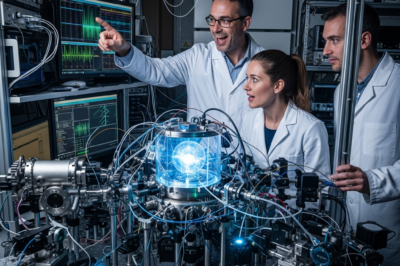
The experiment that finally unlocked this quantum secret was a masterclass in precision engineering and experimental design. Conducted in a state-of-the-art facility, the team utilized a combination of ultra-cold atom traps and advanced laser spectroscopy to create an environment where the quantum effect could manifest. Achieving temperatures just fractions of a degree above absolute zero was critical; at these temperatures, the chaotic thermal motion of atoms ceases, allowing the subtle quantum behaviors to dominate. The researchers employed a technique known as optical latticing, where intersecting laser beams create a ‘crystal’ of light that traps individual atoms in a specific grid. By manipulating the properties of these lasers, the team could simulate the exact conditions predicted by theory. Data collection was equally rigorous, involving high-speed sensors capable of detecting single-photon emissions and changes in atomic state with nanosecond precision. The sheer volume of data generated during the trial required custom-built algorithms to filter out background noise and isolate the signal of the quantum effect. This level of technological sophistication was simply unavailable even a decade ago, illustrating how advancements in hardware and software are directly responsible for pushing the boundaries of fundamental science. The experiment was repeated multiple times to ensure statistical significance, with each run confirming the presence of the effect with unprecedented clarity, effectively ending the debate over its existence.
Deciphering the Quantum Mechanism
At its core, the observed effect involves a unique form of collective behavior among particles that occurs only when certain symmetry conditions are met. In the quantum realm, particles like electrons and photons do not behave as solid balls but as wavefunctions that describe probabilities. When these wavefunctions overlap in a precisely controlled manner, they can interfere with one another to produce phenomena that have no classical analog. The breakthrough experiment observed a specific type of ‘quantum phase transition’ where the particles rearranged themselves into a new state of matter that exhibited properties of both a solid and a fluid. This state, which had been theorized to exist in high-energy environments or deep within the cores of neutron stars, was successfully replicated in a tabletop experiment. The mechanism relies on the principle of quantum coherence, where particles maintain a fixed phase relationship over a distance. Disrupting this coherence usually leads to the collapse of the quantum state, but the researchers found a way to ‘shield’ the system from environmental decoherence, allowing the effect to persist long enough for detailed study. This stability is the ‘holy grail’ of quantum physics, as it suggests that we can control and manipulate these delicate states for practical use without them dissolving instantly into the surrounding environment.
Implications for Quantum Computing and Information Theory
The most immediate and profound impact of this discovery lies in the field of quantum computing. Traditional computers use bits that are either 0 or 1, but quantum computers use qubits, which can exist in a superposition of both states simultaneously. One of the biggest hurdles in building a functional quantum computer is the high rate of error caused by external interference. The newly discovered quantum effect offers a potential solution to this problem by providing a more stable platform for qubit storage and manipulation. Because this effect allows for a more resilient quantum state, it could lead to the development of ‘topological’ qubits, which are inherently protected from most types of noise. This would dramatically reduce the need for complex error-correction codes and allow for the scaling of quantum processors to thousands or even millions of qubits. Furthermore, the discovery has implications for quantum cryptography, enabling the creation of communication channels that are fundamentally unhackable. By leveraging the specific properties of this effect, scientists can ensure that any attempt to intercept a message would immediately alter the state of the system, alerting the users to the breach. This is not just a theoretical improvement; it is a paradigm shift in how we process and protect information in an increasingly digital world.
Revolutionizing Material Science and Energy Efficiency
Beyond the realm of computing, the ability to manipulate matter at the quantum level through this effect has staggering implications for material science. We are looking at the possibility of designing new materials with ‘bespoke’ properties—materials that are perfectly efficient conductors of electricity at room temperature, or substances with extraordinary strength and lightness. The discovery provides a blueprint for how particles can be organized to minimize energy loss, which could lead to a new generation of superconductors. Currently, superconductors require extreme cooling to function, limiting their use to specialized equipment like MRI machines. If the principles of this quantum effect can be applied to create room-temperature superconductors, the impact on the global energy grid would be transformative. We could transmit electricity across continents with zero loss, revolutionize high-speed rail with more efficient maglev technology, and create incredibly powerful magnets for fusion energy reactors. The breakthrough essentially gives us a new set of ‘lego bricks’ at the atomic level, allowing us to build structures that were previously thought impossible by the laws of classical chemistry and physics.
Challenges and the Long Road to Commercialization
While the excitement surrounding this breakthrough is justified, it is important to temper it with the reality of the scientific process. Moving from a laboratory observation to a commercial product is a journey that often takes decades. The current experimental setup, while successful, is extremely complex and expensive, requiring specialized equipment that is not yet scalable. Engineers must now find ways to replicate these quantum effects in more robust, less expensive systems. There are also significant theoretical questions that remain unanswered. While we have observed the effect, fully understanding the underlying dynamics in every possible scenario will require more research and potentially new mathematical frameworks. There is also the challenge of integration; how do we interface these quantum systems with our existing classical infrastructure? The transition will likely be gradual, with quantum-enhanced components appearing in niche high-performance applications before reaching the consumer market. However, the confirmation of the effect is the hardest step; now that we know it is possible, the global research community can focus its resources on optimizing and scaling the technology.
Conclusion: A New Chapter for Humanity
The unlocking of this elusive quantum effect is more than just a win for the physics community; it is a landmark event for humanity. It reaffirms our ability to probe the deepest mysteries of the universe and turn abstract mathematics into physical reality. As we move forward, the lessons learned from this experiment will inform everything from our understanding of the early universe to the development of the next generation of smartphones. We are entering an era where the boundary between the macro and micro worlds is becoming increasingly blurred, allowing us to harness the power of the quantum realm to solve some of the most pressing challenges facing our species. Whether it is through the creation of life-saving drugs via quantum simulation or the development of a sustainable energy infrastructure, the ripple effects of this discovery will be felt for generations. Scientists have finally turned the key to a door that has been locked for nearly a century, and the world that lies on the other side is full of infinite possibility and wonder.






































Leave a Reply