
In Shorts
- Tripura student Anjel Chakma died after a violent attack in Dehradun after alleged racial insults.
- Uttarakhand police say the incident was not racially motivated, calling remarks “in jest.”
- Case has sparked protests and political reactions demanding justice and anti-racism laws.
A tragic incident in Dehradun that left a young student from Tripura dead is now the focus of intense debate across India. Twenty-four-year-old MBA student Anjel Chakma was attacked in early December and succumbed to his injuries after more than two weeks in hospital. The event has ignited public outrage and conflicting interpretations of what sparked the deadly confrontation.
The incident unfolded on December 9 in the Selaqui area of Dehradun, where Chakma and his brother were confronted by a group of men near a roadside canteen. Family accounts and several media reports say the pair were subjected to racial slurs, with derogatory terms allegedly hurled at them because of their appearance. When Chakma objected and asserted their Indian identity, the situation escalated into a violent clash.
According to police officials, however, the altercation did not stem from racial hatred. A senior Dehradun officer stated that remarks made by those involved were shared in a casual setting among the group, and were not targeted at Chakma in a discriminatory way. The force says preliminary investigations have not found evidence to classify the incident as a racial attack. Authorities emphasize that the clash began as a dispute that got out of control, involving individuals who were present in the area at the time.
Chakma was critically injured in the confrontation and taken to a private hospital where he remained under treatment. Despite medical efforts, he died on December 26, leaving his family devastated and triggering demands for justice from students and social groups, especially from the Northeast.
The police have arrested several suspects in connection with the case, including minors, and registered charges that now include murder. One primary suspect is reported to have fled the area and may be in Nepal, prompting police teams to pursue him with a reward offered for information leading to his capture.
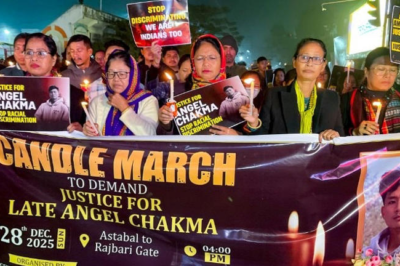
The case has sparked wider debates nationwide about safety and discrimination faced by students from northeastern states when studying or living elsewhere in India. Demonstrations and candlelight marches have been held, with activists and political figures urging stronger protections against hate crimes and racial abuse.
Voices from across the political spectrum and civil society have weighed in, with some condemning any form of racial bias and calling for systemic change, while law enforcement maintains that the evidence does not currently support classifying the attack as motivated by race. As the investigation continues, the nation watches closely for both legal outcomes and broader cultural responses to the case.
































Leave a Reply