
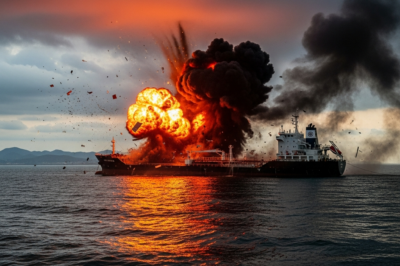
The maritime world was jolted into a state of high alert today as reports emerged of a significant fire and subsequent explosion aboard a South Korean-managed vessel navigating the volatile waters of the Strait of Hormuz. According to initial statements released by the South Korean government and corroborated by Reuters, the incident occurred during the early hours of the morning, sending shockwaves through international shipping corridors and global energy markets. The Strait of Hormuz, a narrow waterway separating the Persian Gulf from the Gulf of Oman, is widely considered the world’s most critical maritime chokepoint. Any disruption in this region is not merely a local incident but a global emergency, given that approximately one-fifth of the world’s total oil consumption passes through this strategic lane daily. This latest development adds a harrowing new chapter to the ongoing instability in the Middle East, where commercial vessels have increasingly found themselves in the crosshairs of geopolitical maneuvering. As the smoke clears, the international community is left grappling with the immediate safety of the crew and the broader implications for global trade security.
The Anatomy of the Incident: Timeline and Initial Reports
The incident began around 11:30 PM local time when the vessel, identified as a medium-range tanker under South Korean management, reported a sudden fire in its engine room compartment. Within minutes, according to distress signals intercepted by the United Kingdom Maritime Trade Operations (UKMTO), a secondary explosion rocked the hull, leading to a partial loss of propulsion and navigation capabilities. Seoul’s Ministry of Foreign Affairs quickly convened an emergency task force to monitor the situation, confirming that the vessel was carrying a crew of 20, consisting of South Korean nationals and foreign workers. While early reports indicate that there were no immediate fatalities, the severity of the damage has left the ship adrift in one of the most congested shipping lanes on the planet. Specialized firefighting tugs from neighboring ports were dispatched immediately, but the risk of a secondary blast or a significant environmental leak remains high. The South Korean government has officially requested assistance from the United States Navy’s 5th Fleet, based in Bahrain, to provide security and technical support as the investigation into the cause of the explosion begins. The nature of the blast—whether it was a mechanical failure, a sea mine, or a targeted drone strike—is currently the subject of intense speculation and rigorous forensic analysis.
Geopolitical Significance of the Strait of Hormuz Chokepoint
To understand the gravity of this explosion, one must understand the unique geography and politics of the Strait of Hormuz. At its narrowest point, the strait is only 21 miles wide, with shipping lanes consisting of just two-mile-wide channels for inbound and outbound traffic. This physical constraint makes vessels extremely vulnerable to both accidental and intentional disruptions. For decades, the strait has served as a primary lever of influence for regional powers, most notably Iran, which has occasionally threatened to close the waterway in response to international sanctions or perceived provocations. The recent history of the region is littered with ‘tanker wars’ and sabotage. In 2019, several tankers were damaged by limpet mines in the Gulf of Oman, an incident the U.S. attributed to Iranian tactical units. More recently, the seizure of the South Korean-flagged MT Hankuk Chemi in 2021 underscored the precarious position of South Korean commercial interests in the region. This new explosion occurs at a time when regional tensions are already at a boiling point due to ongoing conflicts in the Levant and the Red Sea, making the Strait of Hormuz a powder keg ready to ignite with the slightest spark.
South Korea’s Strategic Dilemma and Maritime Presence
South Korea, the world’s tenth-largest economy and a major industrial powerhouse, is almost entirely dependent on imported energy to fuel its manufacturing and transportation sectors. Over 70% of South Korea’s crude oil imports pass through the Strait of Hormuz, making the nation uniquely sensitive to maritime security in the Persian Gulf. The South Korean government has long attempted to balance its strategic alliance with the United States with its need to maintain functional, if not friendly, relations with major oil exporters like Saudi Arabia, Iraq, and Iran. However, this balance has been tested repeatedly. The freezing of several billion dollars of Iranian oil revenue in South Korean banks due to U.S. sanctions led to a prolonged diplomatic standoff, during which South Korean vessels were often singled out for inspections or detentions. This latest explosion puts Seoul in a difficult position. If the investigation reveals that the blast was the result of a deliberate attack, South Korea will face immense pressure to join international maritime coalitions, such as the U.S.-led Operation Prosperity Guardian, which could further alienate regional actors. Conversely, if Seoul remains passive, it risks the safety of its merchant fleet and the stability of its domestic energy prices.
Potential Causes: Sabotage vs. Technical Failure
The primary question currently being debated by maritime security experts is whether the fire and explosion were internal or external in origin. Modern tankers are equipped with sophisticated fire suppression systems and redundant safety protocols designed to prevent engine room fires from escalating into catastrophic explosions. Therefore, a spontaneous blast of this magnitude is relatively rare in the commercial shipping industry. Investigators are looking at several possibilities. First is the use of Unmanned Aerial Vehicles (UAVs) or ‘suicide drones,’ which have become a hallmark of asymmetric warfare in the Middle East. A drone strike on the superstructure or the engine casing could easily trigger the chain of events reported by the crew. Second is the possibility of a limpet mine or an improvised explosive device (IED) attached to the hull, a tactic seen in previous years to disable ships without necessarily sinking them. Third, the potential for a cyber-attack targeting the vessel’s automated systems cannot be ruled out, as modern shipping relies heavily on interconnected digital infrastructure. However, investigators are also careful not to dismiss the possibility of a catastrophic mechanical failure, such as a crankcase explosion or a pressurized fuel line rupture, which could produce similar results. The recovery of debris and the analysis of the blast pattern will be essential in determining the culpability and intent behind the incident.
Global Market Volatility and Environmental Implications
The immediate reaction to the news of the explosion was felt in the global commodities markets. Brent crude prices spiked by nearly 2.5% in the hours following the report, as traders priced in a ‘risk premium’ for oil transiting the Middle East. Insurance companies are also expected to hike ‘War Risk’ premiums for vessels operating in the Persian Gulf, a cost that will eventually be passed down to consumers at the pump. Beyond the economic impact, there is a looming environmental threat. If the structural integrity of the vessel is compromised, it could lead to a massive oil spill in the delicate marine ecosystem of the Gulf. The region is home to several desalination plants that provide the primary source of drinking water for millions of people in the United Arab Emirates, Qatar, and Oman. A significant spill would not only be an ecological disaster for coral reefs and fisheries but also a direct threat to the water security of the entire region. Environmental response teams from across the GCC (Gulf Cooperation Council) have been placed on standby to deploy containment booms and skimmers if the tanker begins to leak its cargo.
Conclusion: A Precarious Future for International Shipping
The fire and explosion aboard the South Korean-run vessel in the Strait of Hormuz serve as a stark reminder of the fragility of the global supply chain. In an era of increasing geopolitical fragmentation, the safety of the high seas can no longer be taken for granted. This incident highlights the urgent need for a more robust and inclusive maritime security framework that goes beyond simple naval escorts. It requires diplomatic breakthroughs that address the underlying grievances of regional powers and a technological leap in vessel self-protection. As the investigation continues, the world watches with bated breath, hoping that this event was an isolated tragedy rather than the opening salvo of a new round of maritime conflict. For South Korea, the incident is a wake-up call to diversify its energy routes and strengthen its maritime defense capabilities. For the rest of the world, it is a sobering lesson in how a single explosion in a narrow strait can resonate across every continent, affecting everything from the price of gas to the stability of the global order. The coming days will be critical in determining whether the international community can de-escalate the situation or if we are headed toward a wider confrontation in the world’s most dangerous waters.




































Leave a Reply