
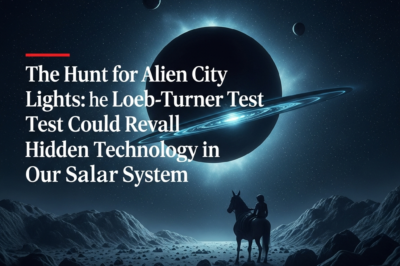
Harvard astrophysicist Avi Loeb is once again challenging the boundaries of traditional astronomy by proposing a rigorous method to detect artificial light sources within our solar system. Based on the Loeb-Turner test, this initiative seeks to identify technosignatures—evidence of alien technology—that may be hiding in the dark reaches of space, far beyond the reach of reflected sunlight. The search targets objects in the Kuiper Belt and beyond, looking for light that does not behave like natural solar reflection.
Understanding the Loeb-Turner Test for Artificial Illumination
The Loeb-Turner test operates on a fundamental principle of physics: the way light intensity diminishes over distance. While a natural object reflects sunlight that weakens proportionally to the square of its distance from the Sun and then travels back to Earth, an artificial light source, such as a city or a probe, would follow a different pattern of luminosity. Specifically, if an object carries its own light source, the flux measured by our telescopes would decrease differently than that of a passively reflecting body. By measuring these variations with high-precision instruments, astronomers can theoretically distinguish between a cold, dead rock and a powered, artificial structure.
The Search for Interstellar Artifacts and Urbanized Asteroids
This approach shifts the search for extraterrestrial intelligence (SETI) from radio waves to optical signatures. Loeb suggests that if an object like Oumuamua were actually a piece of discarded technology, or if advanced civilizations have established outposts in the outer solar system, their artificial illumination could be detectable with next-generation telescopes like the Vera C. Rubin Observatory. This search focuses on our immediate cosmic neighborhood, suggesting that the first evidence of alien life might be much closer than we previously imagined, potentially residing on the very outskirts of our planetary system.
As we advance our observational capabilities, the Loeb-Turner test provides a concrete framework for identifying non-natural phenomena. Whether it leads to the discovery of a lifetime or simply refines our understanding of the solar system’s darkest corners, the pursuit of artificial light marks a bold new chapter in human exploration and the quest to answer if we are truly alone.





































Leave a Reply