
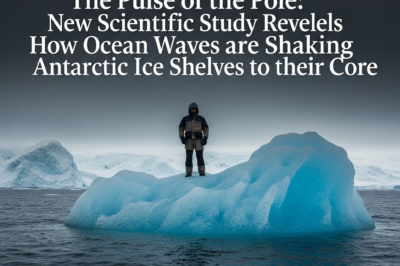
For decades, the vast, frozen expanse of Antarctica has been viewed as a silent sentinel of the planet’s climate health. However, recent scientific breakthroughs have revealed that this icy giant is far more dynamic—and fragile—than we ever imagined. In a groundbreaking study highlighted by Tech Explorist, researchers have uncovered the startling extent to which the world’s oceans are physically shaking the Antarctic ice shelves. This is not merely a metaphor for climate change; it is a literal, seismic reality. Ocean waves, some traveling from thousands of miles away, are causing the massive ice shelves that fringe the continent to vibrate and flex in ways that could accelerate their disintegration. As global temperatures rise and sea levels become a mounting concern for coastal civilizations, understanding this mechanical interaction between the liquid ocean and the solid ice is becoming a matter of existential importance.
The Rhythmic Shaking of a Frozen Continent
The study, which utilized an array of highly sensitive seismometers placed across the Antarctic continent and its floating ice shelves, has provided the first high-resolution map of how wave energy is transferred into the ice. When powerful storms occur in the Southern Ocean or even as far away as the North Pacific, they generate long-period waves known as swell. These waves travel across the globe and eventually collide with the towering walls of the Antarctic ice shelves. Unlike the short, choppy waves seen at a beach, these long-period waves possess immense energy. When they hit the ice, they don’t just splash; they push. This pressure creates seismic waves that ripple through the ice, causing the entire shelf to vibrate like a giant tuning fork. Scientists have long suspected that these vibrations existed, but the scale and frequency revealed in this latest research have sent shockwaves through the glaciological community.
The Mechanics of Wave-Induced Stress
To understand why this matters, one must look at the structural integrity of an ice shelf. These shelves act as massive ‘plugs’ or buttresses that hold back the massive glaciers on the Antarctic mainland. If an ice shelf collapses, the glaciers behind it flow much faster into the sea, directly contributing to sea-level rise. The vibrations caused by ocean waves introduce constant mechanical stress. Think of it like bending a piece of plastic back and forth; eventually, small cracks, known as micro-fractures, begin to form. Over time, these micro-fractures coalesce into larger rifts. The study found that during periods of high wave activity, the ‘shaking’ of the ice is intense enough to widen existing crevasses, making the ice shelf significantly more prone to calving—the process where massive chunks of ice break off into the ocean. This constant ‘hammering’ by the sea is a relentless force that weakens the ice from the outside in.
Technological Marvels in Polar Research
The ability to measure these minute vibrations across such a hostile environment is a testament to modern engineering. The researchers deployed sophisticated seismic sensors capable of operating in temperatures as low as -50 degrees Celsius. These sensors were synchronized with satellite data to correlate wave height in the open ocean with the seismic signals recorded on the ice. One of the most fascinating aspects of the research is the use of ‘ambient noise seismology.’ By analyzing the constant background hum of the ocean, scientists can create an ‘ultrasound’ of the ice shelf, monitoring changes in its thickness and structural health in real-time. This level of monitoring was previously impossible, and it provides a new window into the ‘health’ of the ice that visual satellite imagery alone cannot offer. It allows scientists to hear the ice breaking long before they can see it.
The Synergy of Melting and Shaking
One of the most concerning findings of the recent report is the synergy between mechanical wave action and thermal melting. As the atmosphere and oceans warm, the ice shelves are thinning from both above and below. A thinner ice shelf is a less rigid ice shelf, making it even more susceptible to the vibrations caused by ocean waves. It’s a vicious cycle: as the ice thins, it shakes more violently; as it shakes more violently, it develops more cracks; and as it develops more cracks, more warm ocean water can penetrate the interior of the ice, accelerating the melting process. This ‘multi-pronged’ attack on Antarctic stability is why many scientists are revising their timelines for ice shelf collapse. The interaction between fluid dynamics and solid-state physics is proving to be a critical factor that was largely overlooked in earlier climate models.
Implications for Global Sea Level Projections
The ramifications of these findings extend far beyond the South Pole. Antarctica holds enough ice to raise global sea levels by over 60 meters (nearly 200 feet). While the total melting of the continent would take centuries, even a partial collapse of major ice shelves like the Ross or the Thwaites (often called the ‘Doomsday Glacier’) could result in a catastrophic rise in sea levels within our lifetimes. The discovery that ocean waves are actively ‘shaking’ these shelves suggests that they may be closer to a tipping point than previously thought. Coastal cities from New York to Mumbai, and island nations across the Pacific, are at the mercy of these mechanical processes. By quantifying exactly how much energy is being transferred from waves to ice, researchers can now provide more accurate predictions for future sea-level rise, allowing governments to better prepare for the inevitable changes to our coastlines.
The Future of Antarctic Surveillance
As we move forward, the focus must shift toward continuous, long-term monitoring of these seismic patterns. The study serves as a call to action for increased funding and international cooperation in polar science. We need more sensors, more data, and more sophisticated models to track how the changing frequency of global storms—driven by climate change—will impact the wave energy hitting Antarctica. If the frequency and intensity of ocean storms increase, the ‘shaking’ of the ice will only intensify. This research is a vital piece of the puzzle, but it is just the beginning. Protecting the stability of the Antarctic ice shelves is not just about preserving a remote wilderness; it is about protecting the stability of our global environment. The ‘pulse’ of the Antarctic is a heartbeat we must continue to monitor with the utmost urgency, for the sake of the entire planet.






































Leave a Reply