
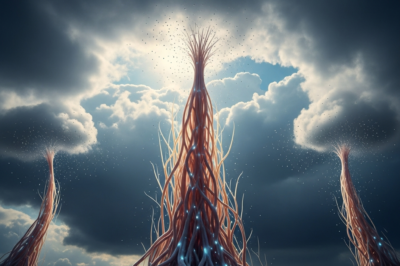
The Hidden Architects of the Sky: A New Paradigm in Atmospheric Science
For centuries, the relationship between the Earth’s flora and the weather was seen as a one-way street: the weather dictated where plants and fungi could grow, providing the moisture and temperature ranges necessary for life. However, a groundbreaking revelation, recently detailed by scientific observers and highlighted by Live Science, suggests that the biological world is far more proactive than we ever imagined. Specifically, fungi—the silent decomposers of the forest floor—are emerging as master atmospheric engineers. New research has finally decoded the exact mechanisms by which these organisms influence precipitation, effectively ‘calling’ the rain to facilitate their own survival and dispersal. This discovery reshapes our understanding of the Earth’s water cycle and highlights a complex, symbiotic relationship between the ground beneath our feet and the clouds overhead. The implications are staggering, suggesting that the very air we breathe and the rain that falls from the sky are deeply intertwined with the lifecycle of mushrooms and molds.
Decoding the Mechanism: How Spores Seed the Heavens
The core of this phenomenon lies in the way fungi reproduce. Most fungi release spores, microscopic biological units that travel through the air to colonize new environments. Scientists have discovered that these spores are not merely passive passengers on the wind; they are active participants in cloud formation. According to the recent findings, when fungi release their spores, they also release a cocktail of hygroscopic (water-attracting) chemicals, including various salts and sugars like potassium and chloride. These chemicals, once airborne, begin to pull moisture from the surrounding air. As the spores drift upward into the troposphere, they act as Cloud Condensation Nuclei (CCN). In simpler terms, they provide a physical surface upon which water vapor can condense into liquid droplets. Without these nuclei, water vapor in the atmosphere would require much higher saturation levels to form clouds. By providing these ‘seeds,’ fungi essentially lower the threshold for cloud formation and, eventually, rainfall.
The Ice-Nucleating Power of Biological Particles
While cloud condensation is one part of the puzzle, the role of fungi in ice nucleation is perhaps even more critical. In many regions, rain begins as ice crystals in high-altitude clouds. Some species of fungi possess specialized proteins on their spore surfaces that can trigger ice formation at temperatures much higher than the freezing point of pure water. While pure water might not freeze until it reaches -38 degrees Celsius in the atmosphere, these fungal ‘ice-nucleators’ can initiate crystallization at temperatures as warm as -4 or -5 degrees Celsius. This ‘warm-temperature’ freezing is a massive catalyst for heavy precipitation. As the ice crystals grow around the fungal spore, they become heavy enough to fall, melting into rain as they reach warmer, lower altitudes. This level of control over the physical state of atmospheric water is a testament to the evolutionary sophistication of fungal life, allowing them to bridge the gap between biological reproduction and planetary meteorology.
The Evolutionary Advantage: Why Fungi Want it to Rain
From an evolutionary perspective, the ability to influence the weather is a brilliant survival strategy. Fungi thrive in moist environments. By inducing rainfall, they ensure that the soil remains damp, which is essential for the growth of mycelium—the underground network of the fungus. Furthermore, many mushrooms utilize ‘active’ spore release mechanisms that require high humidity or liquid water to function. For example, some fungi use a ‘surface tension catapult’ powered by water droplets to launch their spores into the air. By triggering rain, the fungi are essentially creating the perfect conditions for their own offspring to be launched and then deposited into fresh, fertile soil. This creates a self-sustaining feedback loop: the fungus releases spores to reproduce, the spores trigger rain, and the rain facilitates further spore release and growth. This ‘biotic pump’ suggests that large-scale fungal networks, such as those found in the Amazon rainforest, may be responsible for a significant portion of the localized rainfall that sustains the ecosystem.
Implications for Climate Change and Global Modeling
The discovery that fungi play such a pivotal role in weather patterns has profound implications for how we model and predict climate change. Traditional meteorological models have historically focused on inorganic aerosols, such as sea salt, volcanic ash, and desert dust, as the primary drivers of cloud formation. The biological component—termed bio-aerosols—has often been overlooked or undervalued. However, as we now understand that fungal spores can be far more effective at ice nucleation than mineral dust, it becomes clear that biodiversity loss could lead to altered weather patterns. Deforestation doesn’t just remove carbon sinks; it removes the ‘rain-makers.’ When a forest is cleared, the fungal diversity drops, leading to fewer spores in the atmosphere, which can result in decreased rainfall and eventual desertification. Integrating fungal ecology into global climate models is now a priority for scientists seeking to understand the feedback loops that govern our planet’s temperature and hydration.
Statistics and the Scale of Fungal Atmospheric Influence
To grasp the scale of this impact, one must consider the sheer volume of spores released into the atmosphere. It is estimated that fungi release upwards of 50 million tons of spores into the air annually. In certain tropical regions, biological particles can account for up to 80% of the particles found in the air that are capable of forming ice or rain droplets. Researchers using environmental scanning electron microscopy have visualized these spores surrounded by shells of water, proving that they are indeed the focal points of moisture accumulation. Furthermore, studies in the Amazon have shown that during the transition between the dry and wet seasons, the concentration of fungal spores in the air spikes just before the heavy rains begin. This correlation is not coincidental; it is a biological signal that the forest is preparing to irrigate itself. These statistics highlight that the ‘wood wide web’ is not just a subterranean communication network, but an atmospheric one as well.
Future Outlook: Myco-Restoration and Weather Resilience
Looking forward, this research opens the door to innovative strategies for environmental restoration. Could we use specific fungal strains to help combat drought in semi-arid regions? The concept of ‘myco-restoration’—using fungi to heal ecosystems—could expand to include atmospheric management. By planting diverse fungal species along with reforestation efforts, we might be able to stabilize local climates and ensure more predictable rainfall. However, this also serves as a stark warning. Our interference with the soil microbiome through industrial agriculture and chemical fungicides may be having unseen effects on the sky. If we kill the fungi in the soil, we may inadvertently be drying out the air. The realization that fungi are the silent conductors of the atmospheric orchestra reminds us that every part of the Earth’s system is connected. To protect our weather, we must protect the humble mushroom, for it holds the key to the very clouds that sustain life on Earth.







































Leave a Reply