
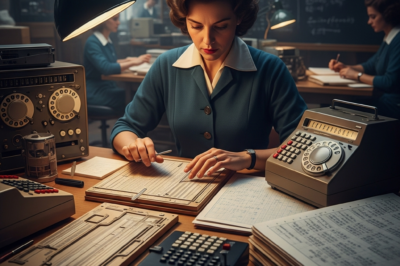
In the high-stakes theater of the mid-20th-century Space Race, the world’s eyes were fixed on the roaring engines of the Atlas rockets and the brave astronauts who dared to sit atop them. Yet, behind the thunderous noise of propulsion and the metallic sheen of capsules lay a silent, rhythmic scratching of pencils on paper. Before the advent of silicon chips and liquid-crystal displays, the complex physics of orbital mechanics was mastered by a group of extraordinary women known as ‘human computers.’ Among them, Katherine Johnson stood as a titan of mathematics, a woman whose brain functioned with the precision of a modern supercomputer long before such technology was viable for flight operations. Her story, recently resurfacing in global headlines, serves as a profound reminder that the foundation of modern space exploration was built not just on hardware, but on the raw intellectual power of individuals who defied both the laws of gravity and the suffocating social constraints of their era. This exploration into the life and work of NASA’s human computers reveals a narrative of resilience, unparalleled genius, and the transition from manual calculation to the digital age that defines our current reality.
The Dawn of the Space Age and the Human Engine
The early 1950s and 60s represented an era of existential competition between the United States and the Soviet Union. As the USSR launched Sputnik and later Yuri Gagarin into orbit, the pressure on the National Advisory Committee for Aeronautics (NACA), which later became NASA, was immense. During this period, electronic computers were in their infancy—massive, unreliable machines that occupied entire rooms and were prone to frequent crashes. To ensure the safety of astronauts and the success of missions, NASA relied on the West Area Computing unit at the Langley Research Center. These women, many of whom were African American, were tasked with performing the intricate mathematical computations required for aeronautical research. Katherine Johnson, a prodigy who had graduated from high school at 14 and college at 18, joined this elite group in 1953. Her work didn’t just involve simple arithmetic; it required a deep mastery of analytical geometry and celestial mechanics. While the engineers designed the hulls and the engines, the human computers calculated the paths they would take through the heavens, accounting for the Earth’s rotation, atmospheric drag, and the gravitational pull of celestial bodies.
Katherine Johnson: The Mathematician Who Guided Friendship 7
Perhaps the most iconic moment in Johnson’s career—and a turning point for NASA—occurred during the preparation for the Friendship 7 mission in 1962. John Glenn was set to become the first American to orbit the Earth, a feat that required pinpoint accuracy in orbital insertion and reentry calculations. By this time, NASA had begun using IBM computers to handle the data, but the technology was still viewed with skepticism by the pilots. Glenn, famously cautious and trusting of human intellect over machine logic, requested that Johnson personally re-verify the computer’s numbers. ‘If she says they’re good,’ Glenn reportedly said, ‘then I’m ready to go.’ Johnson spent days at her desk, manually calculating the same complex equations the electronic brain had processed. Her confirmation that the computer was correct gave Glenn the confidence to launch. This single event highlighted the critical bridge Johnson provided between the era of manual computation and the digital revolution. Her ability to visualize the trajectory of a spacecraft in a four-dimensional coordinate system allowed her to identify errors that machines of the time might have missed.
The West Area Computing Unit: A Legacy of Mathematical Excellence
The success of the American space program was a collective effort of the West Area Computing unit, a segregated group of women who faced the dual challenges of gender discrimination and the systemic racism of Jim Crow laws. Despite working in a segregated facility with separate bathrooms and dining areas, these mathematicians produced work that was beyond reproach. Dorothy Vaughan, who led the unit, and Mary Jackson, who became NASA’s first Black female engineer, worked alongside Johnson to dismantle the barriers within the agency. Their work involved analyzing data from wind tunnel tests, calculating the flight paths for the Mercury and Apollo programs, and even contributing to the mathematical foundations of the Space Shuttle program. The precision required for these tasks was staggering. A mistake in a single decimal point could mean the difference between a successful splashdown and a catastrophic burn-up upon reentry. These women operated with a zero-margin-for-error mindset, documenting their findings in meticulously handwritten reports that remain as masterpieces of applied mathematics.
Breaking Barriers: Intersectionality in Science and Engineering
The story of the ‘human computer’ is not merely a tale of mathematical prowess; it is a significant chapter in the history of civil rights and gender equality. At the time, women in the workforce were often relegated to clerical roles, and Black women faced even steeper obstacles. Katherine Johnson’s persistence in being included in editorial meetings—where women were traditionally excluded—marked a shift in the culture of NASA. She argued that since she did the work, she should be present to explain the results. Her assertive nature, backed by undeniable competence, forced the male-dominated engineering teams to acknowledge her as an equal. This intersectional struggle paved the way for future generations of women and minorities in STEM (Science, Technology, Engineering, and Mathematics). By demonstrating that intellectual capability is independent of race or gender, Johnson and her colleagues became quiet revolutionaries whose calculations propelled humanity toward the moon while simultaneously moving the needle of social progress on Earth.
From Slide Rules to Silicon: The Transition to Digital Computing
As the 1960s progressed, the role of the human computer began to evolve. The introduction of more sophisticated IBM mainframes signaled the end of the era of manual mass-calculation. However, rather than becoming obsolete, Katherine Johnson and her peers became the very people who programmed and validated these new machines. They understood the logic behind the algorithms because they had been the ‘algorithms’ themselves for decades. Johnson’s work on the Apollo 11 mission was instrumental; she helped calculate the trajectory for the Lunar Module’s rendezvous with the Command Service Module. Her deep understanding of the mathematics allowed her to troubleshoot the early digital systems. This transition period was crucial; it ensured that the human intuition for physics was baked into the software that would eventually guide spacecraft to the outer reaches of the solar system. Today, when we look at the high-speed processing of the James Webb Space Telescope or the autonomous landing of SpaceX boosters, we are seeing the direct descendants of the logic structures developed by Johnson and her team.
The Lasting Impact on Modern STEM and Aerospace
The recognition of Katherine Johnson and the human computers came late, but its impact has been monumental. With the publication of Margot Lee Shetterly’s ‘Hidden Figures’ and the subsequent film, the public finally grasped the scale of their contributions. In 2015, President Barack Obama awarded Johnson the Presidential Medal of Freedom, the highest civilian honor in the United States. NASA has since named facilities after her, ensuring that her name is etched into the history of aerospace alongside giants like Neil Armstrong and Wernher von Braun. The legacy of these women serves as a cornerstone for current diversity initiatives in science. It highlights the importance of ‘hidden’ labor—the foundational work that often goes unrecognized but is essential for any grand achievement. In modern classrooms, Johnson’s story is used to inspire young girls to pursue mathematics, showing them that the path to the stars was paved by a woman with a pencil and an unbreakable spirit.
Conclusion: The Human Element in a Digital World
As we look toward the future of spaceflight—with missions to Mars and the establishment of permanent lunar bases on the horizon—the story of the ‘human computer’ remains as relevant as ever. It reminds us that while machines can process data at speeds beyond human comprehension, the fundamental creative leap of understanding ‘why’ and ‘how’ remains a human endeavor. Katherine Johnson’s life was a testament to the power of the human mind to overcome both physical and societal gravity. She did not just calculate trajectories; she calculated the future of a nation and the possibilities of our species. Her legacy is a beacon for any individual who feels overlooked or underestimated, proving that excellence, when combined with courage, can change the course of history. As we continue to push the boundaries of what is possible in the cosmos, we do so on the shoulders of giants like Johnson, whose legacy is written in the very stars she helped us reach.







































Leave a Reply