
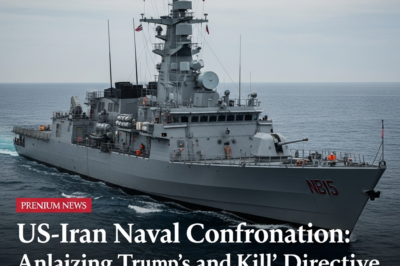
The Escalation of Rhetoric in a Volatile Maritime Corridor
The geopolitical landscape of the Middle East has been thrust into a state of heightened anxiety following a direct and provocative directive from the highest levels of the United States government. President Donald Trump has reportedly ordered the United States Navy to ‘shoot down and destroy’ any and all Iranian gunboats if they harass American ships at sea. This development, surfacing amidst a series of live updates regarding the simmering US-Iran tensions, marks a significant departure from previous rules of engagement and signals a new, more aggressive posture in the Strait of Hormuz. The directive specifically highlights the threat of Iranian vessels planting mines, a tactic that has historically paralyzed commercial shipping and threatened the stability of global energy markets. As the world watches, the prospect of a direct naval clash between the world’s preeminent superpower and the regional powerhouse of Iran looms larger than at any point in the recent decade.
This move is not merely a localized tactical adjustment but a strategic statement intended to project absolute deterrence. For years, the Persian Gulf has been the site of a ‘shadow war,’ characterized by close encounters between the high-tech vessels of the US Fifth Fleet and the agile, fast-attack craft of the Islamic Revolutionary Guard Corps Navy (IRGCN). However, the explicit nature of Trump’s latest order removes the ambiguity that previously governed these interactions. By defining the act of harassment or the placement of mines as a justifiable cause for lethal force, the US administration has significantly lowered the threshold for active engagement. This shift has profound implications for international law, regional stability, and the global economy, as the Strait of Hormuz remains the single most important oil chokepoint on the planet, through which roughly one-fifth of the world’s total petroleum consumption passes daily.
The Strategic Importance of the Strait of Hormuz: A Global Chokepoint
To understand the gravity of the ‘shoot and kill’ order, one must first understand the geography of the conflict. The Strait of Hormuz is a narrow waterway connecting the Persian Gulf with the Gulf of Oman and the Arabian Sea. At its narrowest point, it is only about 21 miles wide, with shipping lanes in either direction being only two miles wide, separated by a two-mile buffer zone. Because of this extreme narrowness, nearly all vessels passing through the strait must enter Iranian territorial waters. This geographic reality gives the Iranian Navy a unique leverage point over global commerce. For decades, Tehran has utilized this leverage, threatening to close the strait in response to international sanctions or military pressure.
The threat of limpet mines is particularly concerning to maritime experts. Limpet mines are small, magnetic explosive devices that can be attached to the hull of a ship, often by divers or via fast-moving small boats. In 2019, several commercial tankers were damaged by such devices, and the United States provided intelligence and video evidence suggesting the IRGCN was responsible. By specifically mentioning mines in the new directive, the US administration is addressing a specific tactical vulnerability. The fear is that a single mine incident could spike global oil prices by 10-20% overnight, causing economic ripples that would be felt from Beijing to New York. The US Navy’s presence in the region is ostensibly to ensure the ‘freedom of navigation,’ a core tenet of international maritime law that Iran frequently challenges as a form of foreign encroachment.
A History of Hostility: From the Tanker War to Operation Praying Mantis
The current tensions are deeply rooted in a history of naval conflict that dates back to the 1980s. During the Iran-Iraq War, both sides engaged in what became known as the ‘Tanker War,’ where they targeted each other’s oil exports and those of their neighbors. This conflict eventually drew in the United States, which launched Operation Earnest Will to escort Kuwaiti oil tankers. The most significant direct clash occurred in April 1988, known as Operation Praying Mantis. After the USS Samuel B. Roberts was nearly sunk by an Iranian mine, the US Navy launched a massive retaliatory strike, destroying two Iranian oil platforms and sinking several Iranian warships. This event remains a foundational moment in the institutional memory of the Iranian military, fueling their development of asymmetric warfare capabilities.
Since then, the relationship has been defined by cycles of escalation and temporary de-escalation. The 2015 Joint Comprehensive Plan of Action (JCPOA), or the Iran Nuclear Deal, briefly reduced the temperature, but the US withdrawal from the deal under the Trump administration in 2018 reinvigorated the conflict. Since then, we have seen the shooting down of a US Global Hawk drone, the seizure of various international tankers by Iranian forces, and the high-profile assassination of Iranian General Qasem Soleimani. Each of these events has contributed to a situation where a single miscalculation in the narrow confines of the Gulf could ignite a full-scale war. The ‘shoot and kill’ order is the latest chapter in this decades-long saga, moving the needle from passive surveillance to active threat neutralization.
Asymmetric Warfare: The IRGCN’s Swarming Tactics and Mines
The Iranian military strategy in the Persian Gulf is not designed to match the US Navy ship-for-ship. Instead, they utilize ‘asymmetric warfare’—a method of using smaller, cheaper, and more numerous forces to exploit the vulnerabilities of a technologically superior enemy. The IRGCN operates hundreds of fast-attack craft equipped with heavy machine guns, rocket launchers, and anti-ship missiles. Their primary tactic is the ‘swarm,’ where dozens of small boats approach a large US warship simultaneously from different directions, attempting to overwhelm its defensive systems and sensors. This environment creates a nightmare for US commanders, who must decide in seconds whether an approaching boat is a harmless fishing vessel or a suicide boat laden with explosives.
Mines represent the ‘silent’ side of this asymmetric strategy. They are inexpensive, easy to deploy from civilian-looking vessels, and incredibly difficult to detect in the murky, high-traffic waters of the Strait. By ordering the Navy to target boats ‘putting mines’ in the water, the US is essentially declaring that the act of deployment is an act of war. However, identifying the act of mine-laying in real-time is an immense intelligence challenge. Critics of the directive argue that it could lead to ‘pre-emptive strikes’ on innocent vessels, further destabilizing the region and providing Iran with a narrative of American aggression. Conversely, proponents argue that only a credible threat of force will prevent Iran from continuing its low-level harassment of international shipping.
Economic Implications: Oil Markets and the Cost of War
The global economy is perhaps the most sensitive barometer of US-Iran tensions. The Persian Gulf produces approximately 25% of the world’s liquefied natural gas and 20% of its oil. Any significant disruption in the Strait of Hormuz would lead to an immediate and catastrophic rise in energy prices. For countries like India, China, and Japan, which are heavily dependent on Middle Eastern oil, a naval conflict would be an economic disaster. Insurance rates for tankers operating in the region have already skyrocketed in recent years, adding a ‘risk premium’ to every barrel of oil transported through the strait. The Trump administration’s order to use lethal force increases this risk exponentially, as it signals that the US is willing to engage in a kinetic conflict that would almost certainly result in the closure of the shipping lanes, even if only temporarily.
Furthermore, the economic pressure is not one-sided. Iran’s economy is currently reeling from ‘maximum pressure’ sanctions that have crippled its oil exports and led to significant domestic inflation and unrest. For Tehran, the threat to disrupt shipping is one of the few remaining cards it can play to force the international community to provide sanctions relief. This creates a dangerous ‘tit-for-tat’ dynamic where economic desperation leads to military provocation, which in turn leads to even harsher military responses. The global market’s reliance on this specific geographic point makes the entire world a stakeholder in whether these naval orders are ever actually carried out.
The International Legal and Diplomatic Chessboard
From a legal perspective, the ‘shoot and kill’ order occupies a grey area of international law. Under the United Nations Convention on the Law of the Sea (UNCLOS), vessels have the right of ‘innocent passage’ through territorial waters used for international navigation. While the US is not a formal party to UNCLOS, it recognizes most of its provisions as customary international law. However, the definition of what constitutes a threat to a warship is often left to the discretion of the ship’s commander. International law generally allows for ‘proportional’ self-defense in the face of an imminent threat. The question that legal experts and international diplomats are asking is whether ‘harassment’ or the deployment of mines qualifies as an ‘imminent threat’ justifying the sinking of a vessel.
Diplomatically, the US order places allies in a difficult position. European nations, while concerned about Iranian behavior, have largely attempted to preserve the remains of the nuclear deal and avoid a military confrontation. They fear that a ‘shoot first’ policy could drag them into a conflict they did not authorize and do not want. Meanwhile, regional actors like Saudi Arabia and the United Arab Emirates, who view Iran as an existential threat, may feel emboldened by the US stance, potentially leading to more aggressive regional maneuvers. The diplomatic challenge remains: how to deter Iranian maritime aggression without triggering a regional war that no one is truly prepared to manage.
Conclusion: The Precarious Balance of Deterrence
As the US Navy prepares to enforce this new directive, the Persian Gulf sits on a knife’s edge. The ‘shoot and kill’ order issued by President Trump is a gamble of the highest stakes—a move designed to restore deterrence through the threat of overwhelming force. While it may succeed in forcing the IRGCN to keep its distance in the short term, it also creates a hair-trigger environment where a small misunderstanding or a technical malfunction could lead to a massive escalation. The history of naval warfare is replete with incidents where unintended actions led to broad conflicts, and in the crowded, tense waters of the Strait of Hormuz, the margin for error has never been thinner. The world now waits to see if this new posture will lead to a more secure maritime environment or if it is the opening salvo of a new and devastating chapter in the US-Iran conflict. One thing is certain: the era of ‘wait and see’ in the Persian Gulf has ended, replaced by a policy of ‘fire at will’ that could reshape the geopolitical map of the 21st century.



































Leave a Reply