
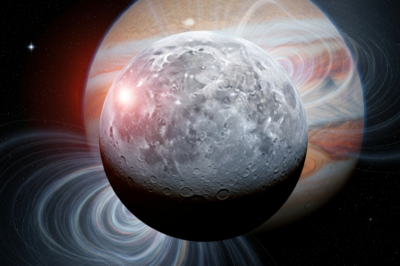
The Mystery of the Jovian Giant: An Anomaly in Our Solar System
In the vast expanse of our solar system, few celestial bodies capture the imagination and scientific curiosity quite like Ganymede. As the largest moon of Jupiter—and indeed, the largest moon in the entire solar system—Ganymede is a world of superlatives. It is larger than the planet Mercury and nearly as massive as Mars. However, its most striking feature isn’t its size, but a phenomenon that was long thought impossible for a satellite of its kind: an intrinsic magnetic field. For decades, the presence of this magnetosphere has remained one of the most significant enigmas in planetary science. While Earth possesses a magnetic field generated by a liquid iron core, the cooling processes of a moon the size of Ganymede should have theoretically halted such a dynamo billions of years ago. Yet, data from NASA’s Galileo mission in the 1990s confirmed that Ganymede is indeed generating its own magnetic protection, carving out a bubble within Jupiter’s own massive magnetosphere. This discovery has led researchers down a rabbit hole of astrophysical theories, culminating in a recent, somewhat ‘strange’ hypothesis that involves ‘iron snow’ falling within the moon’s metallic core.
Decoding the Intrinsic Magnetic Field: How Ganymede Defies the Odds
To understand why Ganymede’s magnetic field is so strange, one must first understand how planetary magnetic fields are typically generated. Most magnetic fields in space are the result of a ‘dynamo’—a process where a rotating, convective, and electrically conducting fluid (like molten iron) converts kinetic energy into magnetic energy. Earth’s dynamo is maintained by the heat escaping from its core, which keeps the outer core liquid and moving. Ganymede, being much smaller than Earth, should have lost its internal heat long ago. Without a source of heat to drive convection, the molten metal in its core should have solidified, effectively ‘killing’ the dynamo. However, Ganymede’s magnetic field is active and strong enough to produce auroras near its poles. This suggests that some hidden engine is still churning deep beneath the icy crust. The presence of this field is not just a curiosity; it is a vital shield. It deflects the intense plasma radiation from Jupiter, which would otherwise strip away any potential atmosphere and bombard the moon’s surface with lethal particles.
The “Iron Snow” Hypothesis: A Chilling Theory of Core Dynamics
A leading theory recently highlighted by researchers to explain this persistence is the ‘iron snow’ model. Unlike Earth’s core, which solidifies from the center outward, Ganymede’s core may be behaving in a far more chaotic and ‘cold’ manner. In this scenario, as the moon’s liquid iron-sulfur core cools, iron-rich crystals begin to freeze out near the top of the core, where the pressure is lower. These solid iron ‘snowflakes’ are denser than the surrounding liquid, causing them to sink toward the center of the moon. As they descend into the hotter, high-pressure depths, they melt back into the liquid, creating a cycle of movement. This ‘snowing’ effect provides the necessary convection to drive the dynamo, even if the moon is significantly cooler than previously thought. This theory is revolutionary because it suggests that planetary bodies can maintain magnetic activity through mechanisms entirely different from those found on Earth or the Sun. It redefines our understanding of ‘geologically dead’ worlds and suggests that many icy moons in the outer solar system might be far more active than they appear on the surface.
The Role of Tidal Heating and Orbital Dynamics
Another critical piece of the puzzle lies in Ganymede’s relationship with its siblings, Io and Europa, and its parent planet, Jupiter. These three moons are locked in a ‘Laplace resonance,’ a gravitational dance where for every four orbits Io makes, Europa makes two, and Ganymede makes one. This resonance creates intense gravitational tugs that stretch and squeeze the moons—a process known as tidal heating. While tidal heating is the primary driver for Io’s extreme volcanism and Europa’s subsurface liquid ocean, its effect on Ganymede is more subtle but equally vital. This constant flexing generates internal friction, which produces heat. Scientists believe this tidal energy might be enough to keep the iron core in a partially molten state, preventing it from fully solidifying and allowing the ‘iron snow’ process to continue. Without this orbital synergy, Ganymede might have become a frozen, magnetically dead rock eons ago. This interplay highlights the complexity of planetary systems, where the life of a moon is inextricably linked to the physics of its neighbors.
Implications for Habitability and Subsurface Oceans
The existence of a magnetic field has profound implications for the search for extraterrestrial life. Ganymede is widely believed to harbor a massive, salty subsurface ocean, potentially containing more water than all of Earth’s oceans combined. This ocean is sandwiched between layers of ice and rock, making it one of the most promising ‘ocean worlds’ in our solar system. The magnetic field acts as a protective cocoon. By diverting the solar wind and Jupiter’s radiation belts, the magnetosphere creates a more stable environment for complex chemistry to occur. Furthermore, the magnetic field interacts with the salty ocean, creating secondary magnetic signatures that scientists use to map the ocean’s depth and salinity. If life exists in the dark, pressurized depths of Ganymede, it may owe its existence to the very magnetic dynamo that scientists are only now beginning to understand. The study of Ganymede’s field is, therefore, not just about physics—it is about the potential for biology in the outer reaches of the solar system.
Future Exploration: JUICE and the Quest for Answers
The scientific community is on the cusp of a new era of discovery with the European Space Agency’s (ESA) JUpiter ICy moons Explorer (JUICE) mission. Launched in 2023, JUICE is currently on an eight-year journey to the Jovian system. Once it arrives, it will perform multiple flybys of Europa and Callisto before eventually entering a dedicated orbit around Ganymede in 2034. This will mark the first time a spacecraft has ever orbited a moon other than Earth’s. JUICE is equipped with a suite of sophisticated instruments, including a magnetometer (J-MAG) that will measure Ganymede’s magnetic field with unprecedented precision. By analyzing the fluctuations in the field, JUICE will be able to confirm whether the ‘iron snow’ theory holds water and determine the exact structure of the moon’s interior. This mission represents a multi-billion dollar bet on the importance of Ganymede as a key to understanding planetary evolution and the habitability of icy moons throughout the universe.
Conclusion: Rethinking the Physics of the Cosmos
The discovery of Ganymede’s magnetic field and the subsequent theories to explain it, such as ‘iron snow,’ serve as a humbling reminder of how much we have yet to learn about our own celestial backyard. What was once thought to be a simple, cold moon has revealed itself to be a complex, dynamic world with an internal engine that defies traditional planetary models. As we look forward to the data from the JUICE mission, we are reminded that the universe often finds ‘strange’ and innovative ways to solve the problems of physics. Ganymede is more than just a moon; it is a laboratory for studying the limits of planetary magnetism and the possibilities of life. Its magnetic shield, generated by a falling snow of iron, remains a testament to the enduring mystery and wonder of the cosmos. As our technology advances, so too will our understanding of these distant giants, potentially revealing that Ganymede is just the first of many worlds that challenge our definitions of what a moon can be.






































Leave a Reply